It's been a good long break since the last post, during which there were medical appointments and Chinese New Year preparations, so I've been busy, sorry! Now that everything is done and work is settling down, I finally found some time to do a simple book cover with a greeting card.
The process of doing this is easy enough because all you really have to do is wrap the greeting card with a cover paper of your choice, so while I was making it, I had time to do some musings over the whole idea of crafting.
This particular occasion, I remembered a line I heard a parent say to a child over the taking up of music in school:
"You don't pursue music all the way unless you want to become a musician. If you don't, then there's no point in pursuing it in school to this extent."
That made me a little sad. We don't pursue a craft just to earn money from it, surely. Yes, it would be great if we did and we could live off what we loved. But, even if we don't get to, even if we have to keep our 9-5 jobs, does that necessarily mean there is no use for the craft that we love to do?
(Here when I write craft, I refer to a interest that we work at for a sustained period of time in order to gain mastery of it. This could include art, craft, playing an instrument, photography, writing etc...)
What then, do we take away from our craft? Do we do it so that one day we could quit our 9-5 jobs? Do we do it just for the end product, to have something pretty to hold in our hands? To have something useful that will serve a meaningful purpose in our lives?
Then what do we gain when we don't achieve what we set out to do? When we fail at it? When we don't make money or a living out of it? Does that mean our craft becomes useless or hopeless?
Think of your craft then not in terms of the material products it produces. Think in terms of the values and skills you learn and then it becomes clearer.
Real life example: When I volunteered for the violin recital, many people thought I was nuts. Even on the day of the recital, after all the practice I did, I still played nearly half the song off key. It would seem like a total bomb, but I still took away several lessons from my recital attempt:
Persistence - To keep trying even when our first attempts bomb. I thought I knew what persistence meant till I volunteered for this and to my horror realized at the start how far out of my depth I was. I had to keep practising and practising to reach a semi-acceptable level and then I realized what real persistence meant.
Mindfulness - To reflect on our mistakes, think of what went wrong and what to do about it in the future. Mindless practising would have seen me playing the song wrongly a hundred times a day. I have to learn deliberate practice, in which after each attempt, I thought about the parts that went wrong and concentrated on making those parts right before going on to the rest of the song. Each time I practised, I had to keep a mindful eye (or ear) out for those parts to make sure I got them right.
Ability to withstand failure - To stand with grace under pressure even amidst total failure. When I finished the recital piece, I knew it wasn't good. But more importantly, I learnt that it was ok that it wasn't good. Life still went on, my family and friends were still around me and I could still continue playing the violin (badly). Whether the rest of the audience thought it was good or not didn't matter because they were so temporary in my life, which would go on even long after they had forgotten my performance.
When I looked at my violin playing this way, then it didn't really matter how well or how badly I played. I still learnt and continued to learn these lessons, which would follow me in other areas of life. And when I looked at the rest of the crafts that I pursued, I could see other values that I had learnt:
Meticulousness - To be exact and deliberate in your activities. My first few crafting and painting attempts were very haphazardly done and it showed. Paper stuck out at the wrong angles, paint jobs were done poorly and I felt it was because I tended to rush through my actions without thought for measurement or precision. Now this works well in some instances, but since I wanted a finished job that looked close to professional, I had to learn to be more meticulous and precise in what I did. Now when I make a new journal, I have learnt to be more exact in the way I cut and paste the paper and I'm a lot more proud of the products I produce.
Patience and self-forgiveness - Things will still go wrong, no matter how hard or often you try. Songs will still be played wrongly, paint will be applied wrongly, paper will be cut or pasted wrongly. At times like this, when I want to throw everything into the rubbish chute in despair, I learn to tell myself to cool down and more importantly, forgive myself for my mistakes. It's ok to make these kind of mistakes and there's always a way to bounce back from them if we are willing to learn. That's important because I also learnt to apply this when I mess up in other areas, like work and tell myself it's ok in the long run, I will bounce back.
So maybe in a way, this is a practice for when my own child faces the same reactions when he wants to pursue his own craft. There will be people who will tell him there's no use or money in it and that he's better off pursuing his career or his job. When they do, I hope I will remember this blog entry so that someone will tell him, "No, there is purpose, life and love in doing what we love and this is how I learnt it."
Showing posts with label photography. Show all posts
Showing posts with label photography. Show all posts
Saturday, March 25, 2017

Saturday, January 14, 2017
#outofthepagesiread - 3 Steps to Mastering Any Subject
It's been a heck of a hiatus after Christmas and New Year, but now that it's officially 2017, time to get working again, especially on the blog! Maintaining the blogging habit has become even more important to me now since we are expecting the little chick to hatch in about a month or two. If I can (hopefully, desperately, crossing my fingers) maintain this blog even during my maternity, I have better hopes of maintaining and even growing it till my chick grows up. Till then, I will just do what little bit I can!
So I'm starting again with #outofthepagesiread and the article I have chosen is apt for anyone who has a new year resolution to learn something new.
The original article was published on Quartz and I have included a handy link for it right here. What it describes is the Feynman technique, named after physicist Richard Feynman, and on first read, it seems ridiculously easy.
In a nutshell...
To learn anything, you would need to do three steps:
1. Teach it to a child
2. Review your learning
3. Organize and simplify
(Don't be lazy, read the original article for more details. It's not that hard, trust me)
Does it work? I tried this method last year when I was learning French on my own. Step 1 seems easy but ho boy, try explaining French verbs in a child-like manner @_@ tres difficile! This took some cracking of brain veins because in order to do this, I had to read the very-adult-jargon-like explanation in my book several times before I could rephrase it to myself as if I was a seven-year-old. The hard part about it is that even when I could do so, I wasn't sure I had explained it correctly after the rephrasing.
This is a powerful step, to be sure, in understanding any subject, but to be really sure of yourself, I think you would need some kind of mentor or study buddy to make sure that you are on the right track.
It worked more when I was learning photography though, because that was a concept I was more familiar with. For example, when I was trying to make myself remember the concept of apertures, I imagined the light beaming through small circles and big circles. Putting it in the form of a visual aid that I might have drawn on the whiteboard to a class of kids worked better for this. Also, because I understood what an aperture was and I had seen it many times on my camera, it was easy to rephrase this concept.
So the key to the first step is understanding. A solid understanding of what you are trying to learn will help you in teaching it to someone who doesn't. If you learning something with a lot of technical jargon, you can try reading a simpler version of it to build your understanding first. Also, you might want to consult someone who is already very knowledgeable about it.
Steps 2 and 3 are much easier and puts me more in mind of how we used to cram for our final exams. Methods may vary, though. I found it easier to put everything on a colourful mind map to see the big picture. Others may prefer other forms of organization. Plus, I realized that I learnt better by writing stuff down on paper while other people may prefer Evernote or other note-taking apps. To each his own in this and you will have to explore a bit to find out what works for you.
So overall...
I find the method easy to remember and doable. It might work for some subjects better than others, but you should still be able to apply it to most things you want to learn. Good luck with your New Year resolutions!
Source:
I read about this method through Jocelyn K. Glei. She writes about creativity and productivity and she produces a weekly email newsletter with great content. This is a link to her website and you can sign up for the newsletter there too.
So I'm starting again with #outofthepagesiread and the article I have chosen is apt for anyone who has a new year resolution to learn something new.
The original article was published on Quartz and I have included a handy link for it right here. What it describes is the Feynman technique, named after physicist Richard Feynman, and on first read, it seems ridiculously easy.
In a nutshell...
To learn anything, you would need to do three steps:
1. Teach it to a child
2. Review your learning
3. Organize and simplify
(Don't be lazy, read the original article for more details. It's not that hard, trust me)
Does it work? I tried this method last year when I was learning French on my own. Step 1 seems easy but ho boy, try explaining French verbs in a child-like manner @_@ tres difficile! This took some cracking of brain veins because in order to do this, I had to read the very-adult-jargon-like explanation in my book several times before I could rephrase it to myself as if I was a seven-year-old. The hard part about it is that even when I could do so, I wasn't sure I had explained it correctly after the rephrasing.
This is a powerful step, to be sure, in understanding any subject, but to be really sure of yourself, I think you would need some kind of mentor or study buddy to make sure that you are on the right track.
It worked more when I was learning photography though, because that was a concept I was more familiar with. For example, when I was trying to make myself remember the concept of apertures, I imagined the light beaming through small circles and big circles. Putting it in the form of a visual aid that I might have drawn on the whiteboard to a class of kids worked better for this. Also, because I understood what an aperture was and I had seen it many times on my camera, it was easy to rephrase this concept.
So the key to the first step is understanding. A solid understanding of what you are trying to learn will help you in teaching it to someone who doesn't. If you learning something with a lot of technical jargon, you can try reading a simpler version of it to build your understanding first. Also, you might want to consult someone who is already very knowledgeable about it.
Steps 2 and 3 are much easier and puts me more in mind of how we used to cram for our final exams. Methods may vary, though. I found it easier to put everything on a colourful mind map to see the big picture. Others may prefer other forms of organization. Plus, I realized that I learnt better by writing stuff down on paper while other people may prefer Evernote or other note-taking apps. To each his own in this and you will have to explore a bit to find out what works for you.
So overall...
I find the method easy to remember and doable. It might work for some subjects better than others, but you should still be able to apply it to most things you want to learn. Good luck with your New Year resolutions!
Source:
I read about this method through Jocelyn K. Glei. She writes about creativity and productivity and she produces a weekly email newsletter with great content. This is a link to her website and you can sign up for the newsletter there too.
Thursday, December 08, 2016
Film Can Pen Holder
I've been a bit on an organizing binge, because 1) the mess on my desk was getting to me and 2) I had too many materials all over the place. That tells me it's time to do some upcycling and make some good out of the stuff that I have!
I had this idea for the pen holder because I have a few small markers which needed a good home and I also had tons of empty film cans from photography. Why not combine the two?
This project is super easy and I can see even small children doing it. It took me less than 10minutes to complete each holder.
Film Can Pen Holder
You will need:
Empty film can
Washi tape
Adhesive of your choice ( I used double-sided tape )
Instructions:


 Step 3: Stick the cover to the bottom of the film can to form the base. Then put your markers inside and admire your craftiness.
Easy right?? I love this so much because the steps are so easy and yet the results are so cute to look at! Craftier people than me can try the following variations:
- Decorate the can with paint instead of washi tape.
- Make the can taller by cutting the bottom out of one can and then sticking it to another can.
- Cut the can in half and use it to store small items like paper clips.
- Fill the completed film can with uncooked rice or beans, then stick pens into it.
Those are just some wild ideas, completely untested! Let me know if you tried any of them and whether they worked!
I had this idea for the pen holder because I have a few small markers which needed a good home and I also had tons of empty film cans from photography. Why not combine the two?
This project is super easy and I can see even small children doing it. It took me less than 10minutes to complete each holder.
Film Can Pen Holder
You will need:
Empty film can
Washi tape
Adhesive of your choice ( I used double-sided tape )
Instructions:


Step 1: Cover the film can with the washi tape of your choice. Here, you can see I chose two different kinds, one a solid colour and one with holiday scenery on it.

Step 2: Stick your adhesive to the top of the cover of the film can. I used double sided tape because that's what I have, but you can use any adhesive you like.

Easy right?? I love this so much because the steps are so easy and yet the results are so cute to look at! Craftier people than me can try the following variations:
- Decorate the can with paint instead of washi tape.
- Make the can taller by cutting the bottom out of one can and then sticking it to another can.
- Cut the can in half and use it to store small items like paper clips.
- Fill the completed film can with uncooked rice or beans, then stick pens into it.
Those are just some wild ideas, completely untested! Let me know if you tried any of them and whether they worked!
Sunday, August 14, 2016
Reflections on July
It's with a mild sense of panic that I realize that we are officially in the 2nd half of the year. What have I done?? What have I accomplished? How am I going to do all the other stuff I wanted to do????
Last month onto this, I got hit off the tracks when I went off on holiday and I came back to a flurry of work. This has happened many times before, when I went overseas or took a long break and not just on my personal goals, but at work as well. Suddenly I forgot how to write my to-do lists, how to remember my deadlines, how to set goals for myself and then everything rushes in together.
So mid-August is a good time to take a quick stock check. Where am I with my goals? What did I accomplish? How did I do it? What did I fail in? Why did I fail? How can I set myself up to pass next time?
My goals for July were:
Photography: To read up on Daido Moriyama
I found this hard at first because books on Daido Moriyama were crazily hard to find. I thought I would be able to buy a good book on him and read it at my leisure, but then I couldn't find any good (or affordable) photo book or biography anywhere in the major bookstores! A photobook seller in Peninsula finally told me that was the case with his books and that the same situation existed in Japan, where his books are primarily sold. -_-!!!
Finally though, I hit paydirt at the National Library - I found Tales of Tono, Stray Dog and Memories of a Dog.
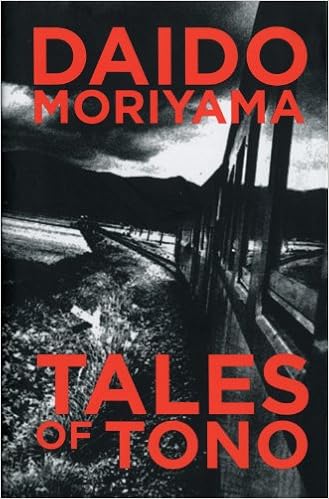
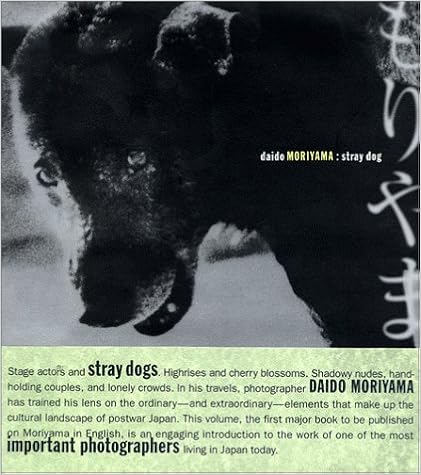
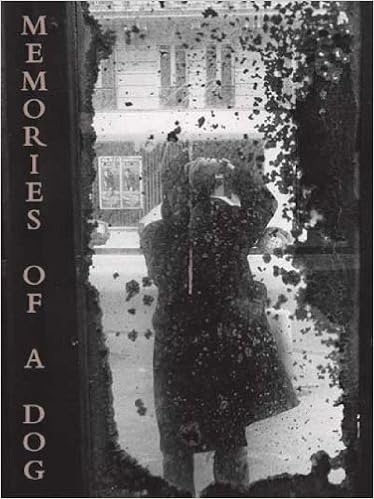
Stray Dog and Memories of a Dog were only available in the reference section, so I couldn't borrow them out. I had to make special trips to Victoria Street to read them, which made them more troublesome and at the same time, more fascinating. (Why some books end up in the reference section, I don't know) The more I read about him, the more fascinated I became with him as a photographer since I identified with certain parts of his philosophy towards photography.
But... that's a subject for another blog post. Let me write up my notes into something coherent first. :p
So I would say in this goal I was fairly successful. I managed to find the books though reading them was quite troublesome. I also learned quite a bit as well.
Next step to levelling up? Getting my essay done... (sigh)
Violin: To practise at least twice a week - COMPLETE FAIL
This goal is one I continuously set for myself and continuously fail at. Every month that I tell myself to practise, to practise, the violin stays neglected in its case and next thing I know, it's time for lesson/practice time again. -_-!!!
So let's take a good hard look at meself: Why am I failing at this?
I'm restricting myself to practising in the afternoon. I keep telling myself to practise in the afternoon because I'm worried about neighbours complaining if I practise at 8-9pm. Which means, if I'm stuck at work till late, I end up not practising at all if I return home after dinner. Would my neighbours really raise their pitchforks if I practised at 8, after dinner and yet when people are not going to bed yet? I don't know because I never tried, having spent most of that time watching TV while eating dinner. -_-!!!
And then at night, there's always other stuff to do...... Easier stuff like reading or painting that doesn't require the same amount of effort as the violin. So I always take the easy way out for myself.
Terrible. It's like wanting to lose weight but eating another chicken burger. I keep telling myself I want to be a good violin player but I fail to put in the practice needed.
The solution for this is easy in principle, yet another matter in practice. I need to set practice days and times (which I have been doing) and actually set about to doing it, never mind fatigue or complaints (which I have NOT been doing).
Watercolour: To paint at least 2 pieces in watercolour.
This goal I managed because I was so lousy with keeping the one about the violin practice. :D I did a few pieces and here are the 3 better ones:


The one I'm most proud of is of course, the 3rd one, and this is one goal I felt I showed the most progress in the least amount of time and the one I enjoyed the most.
There were several things that made this goal easier to accomplish. One, paint and brush were always within easy reach on my table. All I really had to do was plonk my butt on my chair and open them up to start. This also made them a good destresser from work as well. Compare this to having to heft my violin up and stand for the entire time I practise......
Also, having a reference book helped. That way, I didn't have to think of what to practise. I just opened to the last page I stopped at and did whatever was on that page. Again, a good remedy for a hard day at work.
Lastly, I also think that the artwork was a strong visible motivator. Once the painting was done, it was an obvious indicator of my effort and progress and one that could be looked at again and again for inspiration. Whereas with violin playing, I couldn't tell whether my pitch really was improving or not.
All in all, no wonder I found more fun in reaching the art goal.......
Still, they are things to consider if I want to become a good violin player. So with those in mind, my goals in August are:
French - To refresh what I learned and complete at least 2 more chapters
Writing - To work on the text for my book idea
Violin - Once again.........
Wish me luck!
Last month onto this, I got hit off the tracks when I went off on holiday and I came back to a flurry of work. This has happened many times before, when I went overseas or took a long break and not just on my personal goals, but at work as well. Suddenly I forgot how to write my to-do lists, how to remember my deadlines, how to set goals for myself and then everything rushes in together.
So mid-August is a good time to take a quick stock check. Where am I with my goals? What did I accomplish? How did I do it? What did I fail in? Why did I fail? How can I set myself up to pass next time?
My goals for July were:
Photography: To read up on Daido Moriyama
I found this hard at first because books on Daido Moriyama were crazily hard to find. I thought I would be able to buy a good book on him and read it at my leisure, but then I couldn't find any good (or affordable) photo book or biography anywhere in the major bookstores! A photobook seller in Peninsula finally told me that was the case with his books and that the same situation existed in Japan, where his books are primarily sold. -_-!!!
Finally though, I hit paydirt at the National Library - I found Tales of Tono, Stray Dog and Memories of a Dog.
Stray Dog and Memories of a Dog were only available in the reference section, so I couldn't borrow them out. I had to make special trips to Victoria Street to read them, which made them more troublesome and at the same time, more fascinating. (Why some books end up in the reference section, I don't know) The more I read about him, the more fascinated I became with him as a photographer since I identified with certain parts of his philosophy towards photography.
But... that's a subject for another blog post. Let me write up my notes into something coherent first. :p
So I would say in this goal I was fairly successful. I managed to find the books though reading them was quite troublesome. I also learned quite a bit as well.
Next step to levelling up? Getting my essay done... (sigh)
Violin: To practise at least twice a week - COMPLETE FAIL
This goal is one I continuously set for myself and continuously fail at. Every month that I tell myself to practise, to practise, the violin stays neglected in its case and next thing I know, it's time for lesson/practice time again. -_-!!!
So let's take a good hard look at meself: Why am I failing at this?
I'm restricting myself to practising in the afternoon. I keep telling myself to practise in the afternoon because I'm worried about neighbours complaining if I practise at 8-9pm. Which means, if I'm stuck at work till late, I end up not practising at all if I return home after dinner. Would my neighbours really raise their pitchforks if I practised at 8, after dinner and yet when people are not going to bed yet? I don't know because I never tried, having spent most of that time watching TV while eating dinner. -_-!!!
And then at night, there's always other stuff to do...... Easier stuff like reading or painting that doesn't require the same amount of effort as the violin. So I always take the easy way out for myself.
Terrible. It's like wanting to lose weight but eating another chicken burger. I keep telling myself I want to be a good violin player but I fail to put in the practice needed.
The solution for this is easy in principle, yet another matter in practice. I need to set practice days and times (which I have been doing) and actually set about to doing it, never mind fatigue or complaints (which I have NOT been doing).
Watercolour: To paint at least 2 pieces in watercolour.
This goal I managed because I was so lousy with keeping the one about the violin practice. :D I did a few pieces and here are the 3 better ones:


The one I'm most proud of is of course, the 3rd one, and this is one goal I felt I showed the most progress in the least amount of time and the one I enjoyed the most.
There were several things that made this goal easier to accomplish. One, paint and brush were always within easy reach on my table. All I really had to do was plonk my butt on my chair and open them up to start. This also made them a good destresser from work as well. Compare this to having to heft my violin up and stand for the entire time I practise......
Also, having a reference book helped. That way, I didn't have to think of what to practise. I just opened to the last page I stopped at and did whatever was on that page. Again, a good remedy for a hard day at work.
Lastly, I also think that the artwork was a strong visible motivator. Once the painting was done, it was an obvious indicator of my effort and progress and one that could be looked at again and again for inspiration. Whereas with violin playing, I couldn't tell whether my pitch really was improving or not.
All in all, no wonder I found more fun in reaching the art goal.......
Still, they are things to consider if I want to become a good violin player. So with those in mind, my goals in August are:
French - To refresh what I learned and complete at least 2 more chapters
Writing - To work on the text for my book idea
Violin - Once again.........
Wish me luck!
Sunday, July 03, 2016
Henri Cartier-Bresson [What I learned]
Readers of my blog [few you may be, but much treasured!] will know that I had just finished reading The Mind's Eye by Henri Cartier-Bresson, one of the most well-known photographers of the 20th century and responsible for the concept of the 'decisive moment'. After that, I was intrigued enough to find out more, so I bought another book which was a mix of biography and photo portfolio to learn more about him.
What I read was exciting in that it made me think more about what photography meant to me. There were lessons I picked up from the book and from his work, some of which I felt could be applied to my own photography skills, some I couldn't quite agree with, but hey, you can't win them all. These I have put in the form of Nutshells for me to remember much more easily.
So here, in a nutshell, are:
Know your Geometry
The Golden Ratio, the Golden Mean, the Rule of Thirds, Cartier-Bresson considered knowledge of these essential for good photography and used them in many of his most famous work. To him, you had to have a good understanding of how geometry affected composition to take a good photo. "In the beginning, there was the Word... Well, in my case: 'In the beginning, there was geometry.'" he said in an interview.
What I've Done
This shot is one that I feel shows geometry. The man is walking along a path which acts as a line of symmetry between the blocks of flats which flank him on either side. A flaw might be that the trees are not exactly symmetrical but at least they break up the monotony of the flats. (Plus, you can't always choose to move trees!) Could this shot have worked without the man? I don't think so, because I feel he adds some human element to it.

Nutshell: Be familiar with rules of composition and apply them in your photos.
Get yourself in and look at people.
No staying behind the camera and no selfie sticks for Cartier-Bresson. To really know where to catch the action, you have to be a participant in it. That means no telephoto lens from a distance, unless you are a tabloid paparazzi. Get into the midst of things, observe the people around and get up close to them.
What I've done
To get my shots at the CNY bazaar in Chinatown, for one, I actually had to be in the bazaar, instead of driving through in a car, or standing at the side alleys! I also had to observe the people around me and how the stall owners and customers were interacting.

Nutshell: Observe what's around you and participate
The last nutshell is one I especially like, that seems to encapsulate everything about photography:
“To photograph: it is to put on the same line of sight the head, the eye and the heart.”
Taken from Goodreads.
So have the head remember the rules, have the eye observe all and let your heart tell you when to press the shutter button. Practise, practise, practise till all of it is so embedded in your head it becomes a reflexive action. And take at least 10,000 photos. :)
What I read was exciting in that it made me think more about what photography meant to me. There were lessons I picked up from the book and from his work, some of which I felt could be applied to my own photography skills, some I couldn't quite agree with, but hey, you can't win them all. These I have put in the form of Nutshells for me to remember much more easily.
So here, in a nutshell, are:
My HCB Nutshells
Know your Geometry
The Golden Ratio, the Golden Mean, the Rule of Thirds, Cartier-Bresson considered knowledge of these essential for good photography and used them in many of his most famous work. To him, you had to have a good understanding of how geometry affected composition to take a good photo. "In the beginning, there was the Word... Well, in my case: 'In the beginning, there was geometry.'" he said in an interview.
What I've Done
This shot is one that I feel shows geometry. The man is walking along a path which acts as a line of symmetry between the blocks of flats which flank him on either side. A flaw might be that the trees are not exactly symmetrical but at least they break up the monotony of the flats. (Plus, you can't always choose to move trees!) Could this shot have worked without the man? I don't think so, because I feel he adds some human element to it.

Nutshell: Be familiar with rules of composition and apply them in your photos.
Get yourself in and look at people.
No staying behind the camera and no selfie sticks for Cartier-Bresson. To really know where to catch the action, you have to be a participant in it. That means no telephoto lens from a distance, unless you are a tabloid paparazzi. Get into the midst of things, observe the people around and get up close to them.
What I've done
To get my shots at the CNY bazaar in Chinatown, for one, I actually had to be in the bazaar, instead of driving through in a car, or standing at the side alleys! I also had to observe the people around me and how the stall owners and customers were interacting.

Nutshell: Observe what's around you and participate
The last nutshell is one I especially like, that seems to encapsulate everything about photography:
“To photograph: it is to put on the same line of sight the head, the eye and the heart.”
Taken from Goodreads.
So have the head remember the rules, have the eye observe all and let your heart tell you when to press the shutter button. Practise, practise, practise till all of it is so embedded in your head it becomes a reflexive action. And take at least 10,000 photos. :)
Thursday, June 23, 2016
June's Book review: The Mind's Eye by Henri Cartier-Bresson
So you might have noticed things have been slow on the blog for the past 2 weeks, that's because I've been on holiday! Now that I'm back, there's so much to catch up on doing! I want to:
- blog about the ideas I've been having
- Finish the travel journal of my trip
- Think about some new goals for July
- Think about how to upgrade some of my hobbies
And lastly, I have to think about how to start on some of the above! So I will start with a book review of a book I was reading in June.
The Mind's Eye by Henri Cartier-Bresson
 Henri Cartier-Bresson was a photographer and photojournalist. Born in France in 1908, he passed away in 2004. He took many iconic photos throughout his travels as a photojournalist and is most famous for coining the concept of the 'decisive moment'. (More on that later.) The book is a compilation of his writings from his photobooks and also includes essays on his travels.
I bought this book a long time back because I was intrigued by the idea of the decisive moment. I took it to mean a sudden instant in time where suddenly a great photographic shot would present itself. Before I left overseas, I thought it would be good to read the book on the way so that I might get some insight on how to find that 'decisive moment' on my trip.
While I wasn't entirely wrong about the decisive moment, I wasn't entirely right either as I found out from reading the book. I was intrigued enough to pick up another biography on Cartier-Bresson at a flea market later on holiday to find out more and from that book I learnt more about his style of photography. (blog idea: An essay on Cartier-Bresson!)
I would recommend Part 1 for photography enthusiasts. Here, Cartier-Bresson speaks from his perspective about what photography means to him and draws comparisons between photography and drawing. Keep in mind though that he worked a lot during the era of film, so you may have to understand a bit of film processing to really understand his views on darkroom processing and colour film.
Part 2 and 3 then moves on to essays on his travels and on the people he knows. Here are the chapters that some may skip but if you have to, read what he observes about travelling to Russia or China. After all, photography is not just the blind taking of photos, it is also about capturing life and how do you capture life if you are not a keen observer of it?
Overall, I found the book an easy read and it also inspired me enough to learn more about Cartier-Bresson, which I would write about later. (future blog post!) To me, a book that does that, is a good book indeed. :)
- blog about the ideas I've been having
- Finish the travel journal of my trip
- Think about some new goals for July
- Think about how to upgrade some of my hobbies
And lastly, I have to think about how to start on some of the above! So I will start with a book review of a book I was reading in June.
The Mind's Eye by Henri Cartier-Bresson
I bought this book a long time back because I was intrigued by the idea of the decisive moment. I took it to mean a sudden instant in time where suddenly a great photographic shot would present itself. Before I left overseas, I thought it would be good to read the book on the way so that I might get some insight on how to find that 'decisive moment' on my trip.
While I wasn't entirely wrong about the decisive moment, I wasn't entirely right either as I found out from reading the book. I was intrigued enough to pick up another biography on Cartier-Bresson at a flea market later on holiday to find out more and from that book I learnt more about his style of photography. (blog idea: An essay on Cartier-Bresson!)
I would recommend Part 1 for photography enthusiasts. Here, Cartier-Bresson speaks from his perspective about what photography means to him and draws comparisons between photography and drawing. Keep in mind though that he worked a lot during the era of film, so you may have to understand a bit of film processing to really understand his views on darkroom processing and colour film.
Part 2 and 3 then moves on to essays on his travels and on the people he knows. Here are the chapters that some may skip but if you have to, read what he observes about travelling to Russia or China. After all, photography is not just the blind taking of photos, it is also about capturing life and how do you capture life if you are not a keen observer of it?
Overall, I found the book an easy read and it also inspired me enough to learn more about Cartier-Bresson, which I would write about later. (future blog post!) To me, a book that does that, is a good book indeed. :)
Tuesday, May 10, 2016
The FilmOut Camera
This, my dear readers, is a FilmOut Camera:

Ok, to clarify, I gave it that name because I didn't know what it was called. I went to my usual photolab to develop some shots as usual and I noticed a new toy camera they had.
Not only that, but the box showed that the roll of film was exposed??
(Note: Usually when a film negative is exposed to light, it becomes overexposed and everything on the negative turns white. So when doing film photography, exposing the film negative entirely is a strict no-no.)
I asked to take a look and when they took it out of the box, the film roll was indeed exposed! The key design feature that made this possible was the closeness of the camera to the slit in the roll where the film would exit. The design made it such that the film roll would sit right next to the camera so that the film would be wound from the roll to the other side of the camera (the side of the astronaut in my picture)
I couldn't help it, I just had to give it a try for $20.
Lo and Behold, it works!
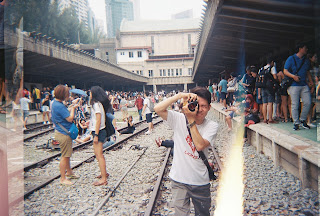
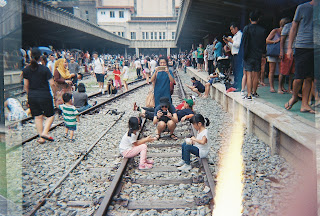

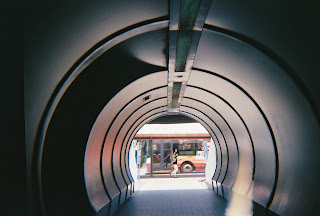


There were caveats, of course:
The camera should be used where there is strong light, or a source of strong light. Such cameras are typical point-and-shoots and they don't have additional features like flashes or light meters to allow you to take nice pictures in dark rooms or at night.
The pictures appear in a continuous panorama. Perhaps because the film wasn't wound enough into the camera, the lab couldn't figure out where to cut the negatives. So you might notice parts of an earlier shot spilling into the next shot, like the 6th shot of the woman at Starbucks.
There are light leaks in each one because I didn't set the film firmly against the camera. That's why you see little stalagmites of light in each shot.
Still it is a unique collector's piece! I still want to bring it out to try again! Bonne chance!

Ok, to clarify, I gave it that name because I didn't know what it was called. I went to my usual photolab to develop some shots as usual and I noticed a new toy camera they had.
Not only that, but the box showed that the roll of film was exposed??
(Note: Usually when a film negative is exposed to light, it becomes overexposed and everything on the negative turns white. So when doing film photography, exposing the film negative entirely is a strict no-no.)
I asked to take a look and when they took it out of the box, the film roll was indeed exposed! The key design feature that made this possible was the closeness of the camera to the slit in the roll where the film would exit. The design made it such that the film roll would sit right next to the camera so that the film would be wound from the roll to the other side of the camera (the side of the astronaut in my picture)
I couldn't help it, I just had to give it a try for $20.
Lo and Behold, it works!


There were caveats, of course:
The camera should be used where there is strong light, or a source of strong light. Such cameras are typical point-and-shoots and they don't have additional features like flashes or light meters to allow you to take nice pictures in dark rooms or at night.
The pictures appear in a continuous panorama. Perhaps because the film wasn't wound enough into the camera, the lab couldn't figure out where to cut the negatives. So you might notice parts of an earlier shot spilling into the next shot, like the 6th shot of the woman at Starbucks.
There are light leaks in each one because I didn't set the film firmly against the camera. That's why you see little stalagmites of light in each shot.
Still it is a unique collector's piece! I still want to bring it out to try again! Bonne chance!
Sunday, May 08, 2016
Women: New Portraits by Annie Leibovitz
Today (Sunday, May 8) I went to the Annie Leibovitz photo exhibition at the Tanjong Pagar Railway Station. Since one of my personal goals is to improve my photography, I thought it would be worthwhile to learn from a master, oops, mistress of the craft.
I was only armed with a humble iPhone and my lacklustre skill, so no comparisons hor...
 The exhibition was sponsored by UBS and it's a world tour which began in London in January. Other countries on the world tour include New York, Zurich, Tokyo and Hongkong.

 While walking, I notice some light and movement inside the old ticket counter. What the...?
When I walked in, I realized they had created a reading nook inside. There were chairs and sofas and photography books from a wide variety of photographers for you to browse through.

 While the area looked tempting, I couldn't stay for more than 5 minutes because it was just too hot! There were 2 reading nooks and both only had the standing air con unit for ventilation so the room became very stuffy and humid very quickly.

 This is the book which you can find her works from the exhibition as well as many more. I think I would rather browse it at Kino......
The print photographs displayed were of various well-known female figures from politics and the arts and others. I don't know if I can accurate pinpoint or describe the Leibovitz style but there were 2 points that struck me in the photos I saw:
She took photos of her subjects in their own comfort zones.
Adele was taken while seated at a piano, a prominent historian was taken while in her study, and a US ambassador in her office. The subjects weren't always the major focus of the photo and they were placed in a setting that expanded our understanding of them. So for example, in the photo of Adele, we do not see her just as Adele, we would see her as Adele, the Musician.
This is interesting because when we think of portrait photography, we always think that we should focus on the person and the face. Most commonly, we think of the studio shot, shot against a plain background. Leibovitz shows that a portrait can be taken out of the studio in order to show more of the character behind the face.
Her subjects show strength and vulnerability at the same time
I'm not sure if this was because of the rapport between the photographer and the subject or because of the subject chosen. Most of the women in the photos seem to show this contrasting dichotomy. Could it be because as working women, we are expected to be strong but yet we still have an inherent softness? Ah, I'll let my feminist friends argue that point out...
Most striking were the 2 photos of Yoko Ono. One was a Rolling Stones cover which showed her and John Lennon in the same bed. The other was a close up of Yoko Ono's face. There seemed to be years of difference between the two but the captions will tell you that the photos were taken only 1 year apart. A few hours after the Rolling Stones cover photo was taken, Lennon was shot. And the grief and misery was clearly apparent on Yoko's 2nd photo.
All in all, I liked the exhibition though I wish that more photos were displayed and that they had better ventilation! If you want to visit, the exhibition is on till 22 May. Read more about the exhibition by clicking on these little highlighted words.
I was only armed with a humble iPhone and my lacklustre skill, so no comparisons hor...


The Exhibition Hall

When I walked in, I realized they had created a reading nook inside. There were chairs and sofas and photography books from a wide variety of photographers for you to browse through.


The print photographs displayed were of various well-known female figures from politics and the arts and others. I don't know if I can accurate pinpoint or describe the Leibovitz style but there were 2 points that struck me in the photos I saw:
She took photos of her subjects in their own comfort zones.
Adele was taken while seated at a piano, a prominent historian was taken while in her study, and a US ambassador in her office. The subjects weren't always the major focus of the photo and they were placed in a setting that expanded our understanding of them. So for example, in the photo of Adele, we do not see her just as Adele, we would see her as Adele, the Musician.
This is interesting because when we think of portrait photography, we always think that we should focus on the person and the face. Most commonly, we think of the studio shot, shot against a plain background. Leibovitz shows that a portrait can be taken out of the studio in order to show more of the character behind the face.
Her subjects show strength and vulnerability at the same time
I'm not sure if this was because of the rapport between the photographer and the subject or because of the subject chosen. Most of the women in the photos seem to show this contrasting dichotomy. Could it be because as working women, we are expected to be strong but yet we still have an inherent softness? Ah, I'll let my feminist friends argue that point out...
Most striking were the 2 photos of Yoko Ono. One was a Rolling Stones cover which showed her and John Lennon in the same bed. The other was a close up of Yoko Ono's face. There seemed to be years of difference between the two but the captions will tell you that the photos were taken only 1 year apart. A few hours after the Rolling Stones cover photo was taken, Lennon was shot. And the grief and misery was clearly apparent on Yoko's 2nd photo.
All in all, I liked the exhibition though I wish that more photos were displayed and that they had better ventilation! If you want to visit, the exhibition is on till 22 May. Read more about the exhibition by clicking on these little highlighted words.
Sunday, April 03, 2016
River Hongbao Festival 2016 and Monkey Kings Galore
[original post: 13 February 2016]
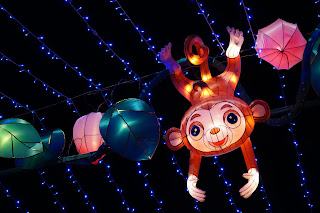
On a Friday night, we went to the River Hongbao festival, held at the Floating Platform. The festival was originally intended to be a showcase of Chinese culture during the Lunar New Year. This year, when I went, it seems more like a light-up display of the Monkey King and a place to get ripped off for food and funfair games. (Whatever makes people happy...)
Regardless, it still makes it an interesting place for a photowalk! For this, I opted for my digital Sony RX5000 because I only had ISO400 film in my film camera, which would not be strong enough to capture the people at the fair. I also used the Intelligent Auto mode, which would automatically choose the best mode to shoot in, so I could concentrate on taking photos.


 "You can buy a balloon from me... If you know where to find me......."


 "Imma gonna BINGO!!!" (Unfortunately, he didn't have 2 numbers to form a straight line. Lesson of Life: The House always wins.)

 And we finish off just in time to see a Monkey King performance at the Esplanade's outdoor theatre.
The River Hongbao ends today, Feb 14, and there will be fireworks at 9pm so try to go around that time if you intend to do so.
On a Friday night, we went to the River Hongbao festival, held at the Floating Platform. The festival was originally intended to be a showcase of Chinese culture during the Lunar New Year. This year, when I went, it seems more like a light-up display of the Monkey King and a place to get ripped off for food and funfair games. (Whatever makes people happy...)
Regardless, it still makes it an interesting place for a photowalk! For this, I opted for my digital Sony RX5000 because I only had ISO400 film in my film camera, which would not be strong enough to capture the people at the fair. I also used the Intelligent Auto mode, which would automatically choose the best mode to shoot in, so I could concentrate on taking photos.
The Light-Up Displays

Monkey see, Monkey do

It's not CNY without the God of Fortune


It being the Year of the Monkey, the Monkey King is out in full force.


The hub surprisingly turned out to be a huge Monkey King drama fan. Having watched several versions of the saga, he could name almost all the characters here.


Pawk, pawk, pawk, pawk........

Here, we saw people throwing coins at this lotus. Turns out that there are bells attached to couplets. Hit 'Gong Xi Fa Cai' and maybe you will strike it rich...? Well, the one who will strike it is most likely the TCM clinic offering free TCM treatment to the needy, because that's where all the coins will go to. All in a good cause......

Most people will aim for 'Xing Xiang Shi Chen' because it's in the middle and pretty much covers every wish you could wish for. Though the hub and I think that if you flung every coin you had at the 5 bells, you are bound to hit at least one of them. The TCM clinic will also be very grateful to you.

I got it!!!!!


Nice... Candy art from China. He pours liquid candy and forms it into the shapes of zodiac animals. (Here he makes a dragon) When he is done, he will stick it onto a stick for you to eat. What a shame to do so, after all it's such a nice piece of art....
The Game Stalls

Lesson of Life: Rising COE prices may mean that this is the only car you will ever get to drive.

"Is he gonna get it?? Is he gonna get it????"

Lesson of Life: It is easier to hook a plastic fish than to hook a good man.


"Step right up! Try your luck!"

The River Hongbao ends today, Feb 14, and there will be fireworks at 9pm so try to go around that time if you intend to do so.
Subscribe to:
Posts (Atom)