No English? No Problem!

Showing posts with label frankiemagazine. Show all posts

Tuesday, February 07, 2017

Junk Journals Tutorial 2: Part 2: Making a Book Cover

Hi all, sorry for the long break! We've been celebrating Chinese New Year here in Singapore and now that it's nearly at an end, it's time for me to finish up this tutorial too!

Today's tutorial covers how to make a cover for your journal and is very useful when you are making journals of your own. Once you have some simple steps mastered, the technique can be applied to making any kind of journal.

Making A Book Cover

You will need:

Tools and Materials
Paper (This would become your cover)
End Paper (Any kind of coloured paper, for the inside of the cover)
Adhesive
Bookbinding stapler (Or ordinary stapler and eraser, if you are following my alternative stapling method)

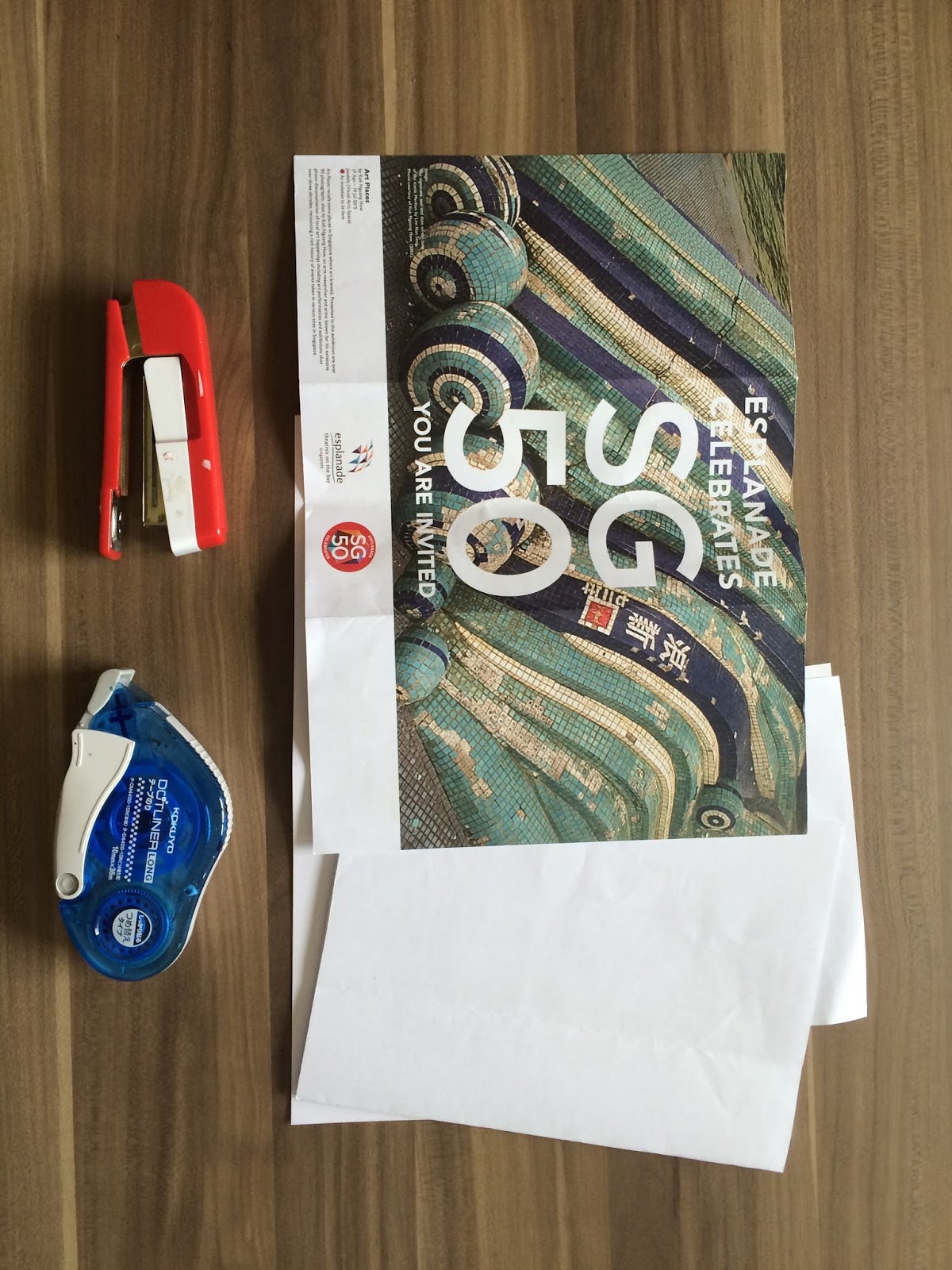
Here, for this tutorial, I have chosen a page out of Frankie magazine as the paper for my cover. The paper from this magazine is quite sturdier and after the end paper is pasted, will become strong enough to act as the cover.

Step 1: Fold the top and bottom edges of the magazine page to your required size. To gauge the size, I've put the paper from Part 1 on top. Leave a few millimetres allowance at the edges.


Step 2: Fold the right side down but cut the corners away. You should have something that looks like the picture above.

Step 3: Take away the notepaper. Stick the right side down. Then do the same on the left side. 


We're almost done. By this point, the top picture shows the inside of the cover and the bottom picture shows the outside after I folded it in half. 

Step 4: Open the cover and stick the end paper of your choice on the inside. Here I chose a piece of white paper to keep a clean look. This will also cover any ugly folding marks you made.

Step 5: Open the cover and open the notepaper to the centre. Clip the notepaper to the cover as if it were a finished book. The clips will keep the paper in place and make it easier to staple.

 Step 6: Turn the whole thing over and staple the paper to the cover.

Done! Here is the finished journal when closed and the tools I used!

Like I said, this tutorial is handy for making covers for any kind of journal or notebook, so save it and keep it handy!

Thursday, December 22, 2016

Junk Journals Tutorial 1 (easy) : The Rough and Dirty Journal

In my past 2 chapters, I covered the why of making Junk Journals and what materials and tools you'd need to get started. Now let's start with an easy tutorial. 

This journal is one of the easiest to get started with, especially if you have the bookbinding stapler I mentioned in Tools and Materials. (If you don't, you can substitute it with other tools. I'll explain later in the post) It will also give you a peek into simple bookbinding. I call it the Rough and Dirty Journal because here we are not so concerned about making it look nice and polished yet so it's going to look a little rough around the edges. However, it's one of the easiest to do if you want to just get started.

Tutorial 1: The Rough and Dirty Journal

You will need:

Tools:
Bookbinding stapler 
(If not, needle and thread or tape)
Adhesive ( I like to use the adhesive tape shown in blue but you can use a glue of your choice )

Materials:
Junk paper (Ensure you have an even number of pages)
1 brochure (For the cover)


Step 1:
Arrange the junk paper together so that the written sides face each other.


Step 2: Use your adhesive to stick both sides together. You should end up with a slightly thicker sheet of paper that is blank on both sides.

Step 3: Arrange your pages together with the brochure on top. Here I have chosen an old programme sheet. Get your stapler ready.

Step 4: Fold everything in half to get a centre fold. Here, you can roughly see what your journal will look like.

Step 5: This is where the beauty of the bookbinding stapler comes in. Open the pages again and flip out the stapler. Then align it where the centre fold is before stapling.

This is a close up of the centrefold. You can see that after that is done, the pages have been stapled very nicely, like a magazine.

Repeat with one more staple on the other side and you are done! Very easy, isn't it?

This journal is still blank, but if you want to see what one looks like after I wrote in it, you can see this previous post on a Rough and Dirty journal that I already did and filled with writing.

Questions! Questions! 
So I know there will be some questions and comments on your mind, let me try to answer as many of them here.

- If you don't have the stapler I used, you can also use a needle and thread and do a basic stitch along the spine to achieve the same look. Also, you can use tape to tape the pages together. 

- If you want a more finished and polished look, you can also trim the edges of the white paper so that they don't stick out of the cover. (But hey, it is a rough and dirty journal after all...)

- For a hardier cover, use a brochure that is made of thicker cardboard or thicker paper. Alternatively, stick the brochure onto another piece of junk paper. 

More questions? Comments?
Leave them in the comment sections below and I'll get back to you as soon as I can! (Be nice, be constructive and I will do the same for you)

Did you try it out? 
I would love to see what you did with your own journals too. If you would like to share, email photos of your journal to me. Remember to include your name, country (optional) and email address so that I can credit your work here!  

Tuesday, December 20, 2016

Junk Journals, Materials and Tools - What would you need to get started?

In the last chapter, I talked about Junk Journals and why I started making them. In this one, I'm going to talk about the materials and the tools I use, and what you would need to get started.

Materials
Of course, you would need paper. Paper can be salvaged from a number of sources, those which I've tried are listed below:

Magazines. Some magazines come printed on good quality paper. After reading it, you can tear out the pages you like. For magazines which are printed on glossy paper, you may have to do some pasting with other writing paper or you may have to paint it with gesso. I'll talk about these later.

Brochures and flyers. Every week, 5 of these get put into my mailbox. I don't think the company intended for me to use them in journals. However, the glossy paper that some of them are printed on means that you may have to do some pasting or painting so that you can use them.

Statements from banks, credit cards, insurance. Word of CAUTION first: Make sure the statements are outdated before you do anything with them! These are also typically printed on good quality paper but you do want to make sure you pay off your credit card bills before you paint over them and forget about them! Also, in the case of bank and insurance statements, make sure all financial affairs are in order before putting them in the junk pile. I would usually have my husband help me to check if the statement needs to be filed before I do anything with it.

Work. Like I mentioned in the introduction, we use tons of paper at work. This is my favourite source of paper because all our work documents get printed on good quality printing paper. If only one side of the paper was used, that means the other side will be gloriously blank. Another word of CAUTION: Make sure you absolutely do NOT need the document anymore before doing anything with it! My practice is to collect the paper in a pile and only use it at the end of the year. 

Free notebooks, notepads and diaries. These may be given out by the banks or sometimes as gifts. I love them because it's easy to change their appearance by wrapping them in a design I like. By now, my friends know of my hoarding instinct so they save any free writing material they get for me. Score one for friendship!

Other advice: Collect paper in a variety of thickness. Soft paper can be used for painting and writing, stiffer and thicker paper can be used to make journal covers. Stiff cardboard can also be cut into strips to bind paper together. (More on that later)

Wow, that's a ton of paper up to use! If you already have all these lying around, what else would you need to transform them into books?

Tools

Basic tools would be:

  1. Scissors for cutting
  2. Glue to stick pages together and pictures on pages


For a more finished look, you can also use:

  1. Needle and thread for basic bookbinding
  2. A bookbinding stapler
  3. Duct tape or bookbinding tape

Now No.2 may sound a little strange but it's a great tool to have to give your journals that really professional zine look, so it's my great pride and joy! They are usually expensive and can't be found in your normal stationery store, so when I found out that Daiso (a $2 shop in Singapore) was actually selling them, I bought one right away! 

This is what my bookbinding stapler looks like: 

 The unique part about it is the white part. It holds the staples and it flips out, as shown below:
 All the way to a right angle.
 This allows you to staple paper right in the middle, and your journal will open very nicely.

This stapler is my pride and joy, considering it only cost $2 but it made my journal-making so much better! I'm tempted to buy it every time I go to Daiso just in case this red one breaks one day!

Then there are other stuff also, that make your journal a whole lot prettier. There are places where you can buy great paper or washi tape to give your journal that extra decorative touch. However, before you go there, you have to read the following:

Crafter's Anonymous - Hi, My Name is...
Personal confession: I don't only use junk paper but I also have a crazy load of craft paper, notepaper and notebooks, some of which I have had for a few years. -_-!!! When I first started scrapbooking, I went a bit crazy and bought almost every paper I thought cute. Then I hoarded them because I became afraid to use them. What if my project turned out ugly?? 

After a couple of years of this, I had the following epiphany:
What it reminds me is that I am here to DO things, not buy them. The paper I buy is meant to help me accomplish and achieve journal-making goals and I would never get anywhere near those goals if all I'm doing is accumulating paper. (Unless your goal is to set up a paper museum) Once that clicked in my head, I decided to throw caution to the wind and just use what I had.

It makes me proud to say that I haven't bought any new paper since but I've been slowly chipping away at my hoarded pile. If you feel like buying some nice paper just to spruce things up in your journal, I wouldn't stop you, but if you are going to spend the money, make sure you really like the paper and make sure you do use what you have. 

But if you really want to spend money on nice stuff...
Now you're done with the warning, here are some of the places I've been to:
(Note: These stores are all in Singapore but some also have websites for you to purchase online)

For paper and scrapbooking materials:
Kikki.k sells all kinds of wonderful stationery and sometimes it takes all my willpower to walk out of here without buying anything. 
Paperstone.sg and Typo Stationery have a great range of notebooks and to-do lists and notepads.
The Paper Market is a dream for me and a nightmare for my bank account. Everything to do with scrapbooking can be found here, like paper, washi tape and stickers.
Daiso sells a good range of craft materials, every one of which can be bought for $2, so if you are on a budget, this is the place to go. (Unfortunately, a Google search only brings up this online store which only allows you to buy in bulk. Singaporeans can find the outlet nearest to them via a quick Google search)

For inspiration and paper:
I also buy some of these magazines for inspiration and er, paper.
Flow Magazine is one for the paper-lovers and those who want life to go a bit more slowly. They sometimes include free gifts for paper-lovers (like journals) and they also release a Book for Paper Lovers every year, which is a thick tome full of beautiful paper.
Frankie Magazine is an Australian magazine full of quirky creative inspiration. They take interesting photos which I sometimes cut out to scrap and they are also printed on good quality paper.
Daphne's Diary is beautifully designed and also comes with paper goodies to cut out. 
Cloth Paper Scissors focuses on art techniques and mixed media and they also have a section on their website on art journalling and handmade books. It's a great source of inspiration.
In Singapore, all these magazines can be found at Kinokuniya or Basheer at Bras Basah Centre. I do recommend calling the stores before going down because they don't get released every month and I have made a few wasted trips before. -_-!!! 

Ok, now you know what you need to get started! Next time, I'll talk about a few easy techniques to start off with!

Sunday, July 24, 2016

Out of the pages I read....

I'm a magazine buyer and hoarder. I love to browse the magazine racks to look for interesting articles and I don't mind spending money on some of the more expensive overseas publications. I do feel the money for the articles is worth spending on because of the quality of the writing. Many of them are also smart enough to manage their content so that what is published on paper is different from what is published online. 

And anyway, isn't it nicer to read on paper than on a screen? ;) 

But at the same time, I do wish that I could get more learning out of the magazines I read. I find sometimes that after reading, the magazine goes into a bag to be thrown away or given away. How would I know that I am retaining the information that I read or even applying them in real life?

So I thought of a plan, namely the

The 3-Stage Magazine Cycle (#outofthepagesiread for a nicer title)

Stage 1: Buy and read
The easiest stage of all, requiring the least effort, haha. 

Stage 2: Read and Do
The hardest stage, because this requires an action to derive something tangible. For the arty magazines like Daphne's Diary, Flow or Mollie Makes, this can be in the form of an art project. For magazines with stories like Frankie, this can be a piece of fiction. For non-fiction like Psychology Today, more essay-style articles. 

(Sounds easy, but the thought of the work involved sends me into shivers actually)

Stage 3: Sell
Just to extract that one last value, attempt to sell the magazine on Carousell and put some funds towards, er, the next magazine. :p Anyone who wants to support me in this step is welcome.......

Mind you, I prefer to do this for the more expensive foreign publications. I think local stuff like 8 Days is cheap enough for me to just read it la.

And another thing,

Why Do I Even Bother?

Firstly, I think it's a great way to get inspiration for art or writing projects. Some magazines like Daphne's Diary and Frankie have beautifully done pages and articles and there have been a number of times I have been inspired by what I read. But I don't always act on them and in the end, no product at the end. So it's a good way to exercise creative muscle.

Secondly, some of these magazines have great information that can't be found locally. Psychology Today has well-researched articles from universities and scientific institutions and it's all very up-to-date. This is information I want to share and remember and writing about it is one way to do so.

Thirdly, I'm hoping this would cut down on mindless magazine buying. Yes, the amount of money I spend on these publications is crazy, sometimes. Sometimes, I even find myself buying them simply because it's a habit to do so. I did this for Oh Comely, till one day, I realized the articles were inciting lesser interest in me and I decided to stop buying it altogether, unless a feature was particularly interesting. 

What's my chance of success?
Right now, I think the difficulty level is very high! Doing craft and writing takes time to do properly, and I'm not sure I can do enough activity at Stage 2 before I buy the next issue! Not only that, but from my short stint selling on Carousell, I also know that Stage 3 also takes up a fair amount of time! Would the money earned back be even worth the effort of trying?

Yet, 

The first reward only comes with the first step.
If I don't even make the first step to try because I was convinced it would utterly fail, I would not get anything at all. At least by starting on it, I can learn something out of it even if I fail miserably. At the very least, maybe it would make me think twice about indiscriminately buying more magazines.

And I already have the first reward, which is a blog article about the plan! Who knows if someone else would stumble onto it and get a great idea to do it? That'll be nice, to think that I passed a good idea along. :) 

So wish me luck! I'm going to start with the first article soon so I can get things done before the next issue comes out!