#outofthepagesiread
One magazine I love buying is Flow magazine. Published by 2 Dutch ladies and translated into English, it has articles on simple living, features on creative artists and comes with beautiful paper goodies, yay :)
The current issue has an article on small changes that spoke to me.
Many people have big dreams stemming from current dissatisfactions. When we are dissatisfied with our house, job or partner, we make big dreams for ourselves in which we shed off all vestiges of our previous life and start afresh. So we might sell the house and move to a hut in Bali, or break up with the partner and move to France to find a new lover.
Of course, once I read this, I immediately saw myself in it. Because every time I face a tough time at work, or I find myself dragged out of bed before dawn, I wish that I was doing something different. I wish that I was running my own art school, or writing books or just being a jobless bum at home.
Whether such solutions solve my problems or not does not feature in my fantasy, of course. That's the point of a fantasy after all, to make you feel better by letting you dream.
The article gives a different idea: that you don't have to take such big steps to making yourself happy and that small steps can be enough. Not everyone can afford drastic steps in their life, or should either. While I don't like the responsibilities that come with my job, I also appreciate very much that the monthly paycheck pays for my house and food while letting me save towards the future! That is not something I might easily get should I decide to quit and write a book!
The dream image though may represent a certain longing that is not being satisfied in your current life. According to the Self-Determination Theory, there are 3 basic needs to be fulfilled to make yourself happier. They are:
1. Autonomy - The need to do it your own way
2. Relatedness - the need to feel connected to other people
3. Competence - the need to do something you are good at
Taking the example of my own life, why is it then I feel dissatisfied at my job? First, the autonomy needs are not met, because much of what I do with the kids are determined by others. The competence needs are not met, because the job requires much planning and meticulousness that I struggle with. And it being a big place, my relatedness needs are not met as well either.
This is also why quitting it all to work on creative pursuits also seems more appealing. I get to do things my own way, paint what I want, write what I want (autonomy). I can meet other likeminded people who share the same creative dreams (relatedness). I can do something I feel I am good at (competence).
But I don't always have to quit it all in order to pursue these needs. Small changes can also be taken as well. I already pursue the competence need by writing and painting in my free time. I pursue the relatedness need by meeting with friends and blogging and posting photos on Instagram.
The autonomy needs... ah, that's a tougher nut to crack. There are commitments of time here that need to be fulfilled. I can meet this sometimes by taking the afternoon off to go on a photowalk, for example, but it's not something I can do every day.
Here, the article talks about thinking in terms of solutions. Rather than paying attention to what's wrong with my life, what can I do then to make it right?
The example given is that of a big miracle. Imagine a big miracle happened and I don't have to work any more. What would I do?
Well, I can imagine long afternoons reading at the library, painting at home or exploring the town with my camera.
Do I necessarily need to quit my job to do this? Actually, I don't. I can spend some afternoons doing these, but planning is required. I would need to plan in advance which days I can get away with leaving the marking at the desk or having nothing at all. Or maybe even play hooky sometimes, hehe.
So there is a solution. The solution is to plan the days I want to do this and then make sure nothing in my afternoon interferes with this plan. And it is a solution that allows me to keep my job and my salary.
My thoughts on this article is that it is a bit simplistic and optimistic at the same time. Simplistic because it's not as if a solution can be found to all of every one's problems. I'm lucky enough because I still have flexibility when it comes to my afternoons, but not everyone who is stuck working 9-5 has the same luck.
But yet, optimistic because it tells you that it is possible to find happiness in the littlest of things. It's not always that you have to make drastic changes to find happiness but if you are aware of what makes you happy, you can make small changes to work towards that happiness. It's something that I try to carry out on a weekly basis and I do see an overall increase in happiness when I did so.
Here are the small steps to do the same:
1. Identify the needs you are lacking. Autonomy, relatedness or competence? Look at your big dream. What is it about it that appeals to you?
2. Create spaces to fulfill those needs in your life. Where can you make time for it? What steps would you need to take?
3. Think in terms of solutions, not problems. It's about what you can do, not how much it sucks.
(adapted from Flow magazine, Issue 14)
Sunday, July 31, 2016

Sunday, July 24, 2016
Out of the pages I read....
I'm a magazine buyer and hoarder. I love to browse the magazine racks to look for interesting articles and I don't mind spending money on some of the more expensive overseas publications. I do feel the money for the articles is worth spending on because of the quality of the writing. Many of them are also smart enough to manage their content so that what is published on paper is different from what is published online.
And anyway, isn't it nicer to read on paper than on a screen? ;)
But at the same time, I do wish that I could get more learning out of the magazines I read. I find sometimes that after reading, the magazine goes into a bag to be thrown away or given away. How would I know that I am retaining the information that I read or even applying them in real life?
So I thought of a plan, namely the
The 3-Stage Magazine Cycle (#outofthepagesiread for a nicer title)
Stage 1: Buy and read
The easiest stage of all, requiring the least effort, haha.
Stage 2: Read and Do
The hardest stage, because this requires an action to derive something tangible. For the arty magazines like Daphne's Diary, Flow or Mollie Makes, this can be in the form of an art project. For magazines with stories like Frankie, this can be a piece of fiction. For non-fiction like Psychology Today, more essay-style articles.
(Sounds easy, but the thought of the work involved sends me into shivers actually)
Stage 3: Sell
Just to extract that one last value, attempt to sell the magazine on Carousell and put some funds towards, er, the next magazine. :p Anyone who wants to support me in this step is welcome.......
Mind you, I prefer to do this for the more expensive foreign publications. I think local stuff like 8 Days is cheap enough for me to just read it la.
And another thing,
Why Do I Even Bother?
Firstly, I think it's a great way to get inspiration for art or writing projects. Some magazines like Daphne's Diary and Frankie have beautifully done pages and articles and there have been a number of times I have been inspired by what I read. But I don't always act on them and in the end, no product at the end. So it's a good way to exercise creative muscle.
Secondly, some of these magazines have great information that can't be found locally. Psychology Today has well-researched articles from universities and scientific institutions and it's all very up-to-date. This is information I want to share and remember and writing about it is one way to do so.
Thirdly, I'm hoping this would cut down on mindless magazine buying. Yes, the amount of money I spend on these publications is crazy, sometimes. Sometimes, I even find myself buying them simply because it's a habit to do so. I did this for Oh Comely, till one day, I realized the articles were inciting lesser interest in me and I decided to stop buying it altogether, unless a feature was particularly interesting.
What's my chance of success?
Right now, I think the difficulty level is very high! Doing craft and writing takes time to do properly, and I'm not sure I can do enough activity at Stage 2 before I buy the next issue! Not only that, but from my short stint selling on Carousell, I also know that Stage 3 also takes up a fair amount of time! Would the money earned back be even worth the effort of trying?
Yet,
The first reward only comes with the first step.
If I don't even make the first step to try because I was convinced it would utterly fail, I would not get anything at all. At least by starting on it, I can learn something out of it even if I fail miserably. At the very least, maybe it would make me think twice about indiscriminately buying more magazines.
And I already have the first reward, which is a blog article about the plan! Who knows if someone else would stumble onto it and get a great idea to do it? That'll be nice, to think that I passed a good idea along. :)
So wish me luck! I'm going to start with the first article soon so I can get things done before the next issue comes out!
Monday, July 18, 2016
Practising with watercolours

My very wet, very unpolished swatches of watercolour. This was a practice on blending the colours but I also added the title and scribbled some notes to, er, make it look more artistic lah... Otherwise it'd be rather boring, no?
I was thinking some thoughts as I was doing this about how little I hear of people actually doing this. I mean this as in
1) give artistic creativity free rein without thought of future reward or consequence and
2) actually bothering to do this rather than watch TV or Youtube. (Yes, my mind does wander even while I'm concentrating on getting the blending right)
To the first, I suppose living in pragmatic Singapore could be part of the cause. A lot of people will not understand the point of spending/wasting time painting ugly stuff when it is pretty clear that there are no benefits to be gained. (ie, you will not be a successful painter/musician/dancer/actor) Even fewer will understand why you do it when it is painfully obvious that you have no clear talent at it. (ie, you suck lah)
A very, very, rare few will understand that it is something that is done simply because you want to do it and get better at it.
I mean, take this exercise in painting. Why am I doing this at all? It has no immediate benefit to my short term future, ie, I'm not going to sell the sketchbook page above for millions one day, nor will I be quitting my job in even the next 10 years to sell watercolour swatches for a million a piece. I'm well aware that to many Singaporeans, what I'm doing is a childish exercise. Yes, yes, very nice rectangles, just like what we did in Primary school. Now grow up and get on with life already.
To others, it is a waste of a limited reserve of effort. Some people will say at this point, "Life is so hard, we work all day, take care of children/parents/pets at night, why would you do something as tiring and fruitless as this? Iphone/iPad/TV/Internet/Facebook is easier lah." or "I have no energy to do this after work. I'm so tired I would rather just lie on the couch with the cats."
Yes, I do have a lot of inner critics and I hear this all the time. (The only one I'd grant the excuse of tiredness is the parent. Yes, I think I would be tired too.)
Which means I also learned ways to counter them.
1) Not everything is about immediate gain and visible show of talent. True success comes also from grit and perseverance. Which is why I believe it's important that I not only show the successes on my blog, but I also show the duds, like the practice page above.
2) Equally important is also what you learn from the duds. You either learn that you suck as a loser, or that you have some stuff you need to improve. One of these lead to better mental health and I think it is clear which.
3) Spending time like this on a hobby takes sweat, grit and effort, I admit. You actually have to pay money for the paint, brushes, paper and book to learn and there have been many times when I come home exhausted, able to do nothing other than lie on my sofa with the cats and the nut. TV at that point is very tempting.
Then after a while, I realised that I wasn't achieving anything (other than a waistline). Spending my time like this, what did I have to show for in my life? What excuse did I have for all my unfulfilled hopes, dreams and aspirations?
More importantly, if I went on like this, what example would I show any future kids of mine? What do I have of me that my kids can look up to? What will people say at my funeral? "Oh, she watched a lot of Doctor Who, and maybe some CSI." That's when I cracked out the paints and the books. At the end of my life, I'd like people to talk and laugh over the millions of bad paintings I did, the horrible photos I took and the fugly craft projects I did and from there, create a picture of me as a whole person, with likes, dislikes, talents, screw-ups and all the stuff I did in my life to show for it.
Maybe, if I'm lucky, by the end of my life, I'd even have a good number of good stuff to show for my efforts too.
Till then, I want to keep trying in every little way I can. Even baby steps will help a baby to stand up on its own one day.
Sunday, July 17, 2016
Refillable Junk Mail Journal
I have a love of paper and journals and I can't deny it. Yet, I'm growing more hesitant to buy journals, no matter how beautiful they are. Firstly, I can't fill them all fast enough. Secondly, there seems to be so much paper floating about that to contribute to that seems wrong somehow. Every week I get sent letters from insurance companies, bank statements that I only need to read once and other mail congratulating me on receiving this wonderful opportunity to...... you get the idea.
So why not make something that satisfies the need to craft, makes use of all that junk mail and also land you with a nice new journal at the same time? Have I got your attention yet? Hahaha...
This journal is more like a small holder. You can fold A4 letters in half and slide them into the flaps to form the notebook. I have made a version of this journal with sturdy envelope packaging, but this time I started with brochures and pamphlets. I used patterned endpaper for the inside covers that I bought from Daiso, part of my 'stock'. It is easy to make if you can understand my crummy instructions... -_-!!!
Refillable Journal
You will need:
- One large brochure (for the front and back cover)
- At least 2 pieces of card (I used theatre flyers)
- A piece of paper for the inside cover
- Scissors
- Glue
- Stickers to decorate (optional)
Steps
1.


 Take the fat bit and unfold it. Then make another fold 5mm away. You should see 2 fold lines like what I have.


 Decorate with stickers if you fill the need.

So why not make something that satisfies the need to craft, makes use of all that junk mail and also land you with a nice new journal at the same time? Have I got your attention yet? Hahaha...
This journal is more like a small holder. You can fold A4 letters in half and slide them into the flaps to form the notebook. I have made a version of this journal with sturdy envelope packaging, but this time I started with brochures and pamphlets. I used patterned endpaper for the inside covers that I bought from Daiso, part of my 'stock'. It is easy to make if you can understand my crummy instructions... -_-!!!
Refillable Journal
You will need:
- One large brochure (for the front and back cover)
- At least 2 pieces of card (I used theatre flyers)
- A piece of paper for the inside cover
- Scissors
- Glue
- Stickers to decorate (optional)
Steps
1.

Place a piece of A4 junk mail on top of the brochure. Fold the long edges of the brochure inwards to fit the junk mail. Leave around 2-3mm allowance so that you can put more junk mail inside. Take note of which side you will use for the front cover, especially if there's a particular picture you want.
2.

Fold the junk mail and brochure in half. You will now have a centre fold for the brochure and the junk mail. Now fold the short edges inwards. Again, leave 2-3mm allowance for more paper in the future.
3.


Remove the junk mail and paste the pieces of card inside. This is to strengthen the covers. Leave a space in between the cards for the spine. Your cover will then look like the picture on the right.
3.
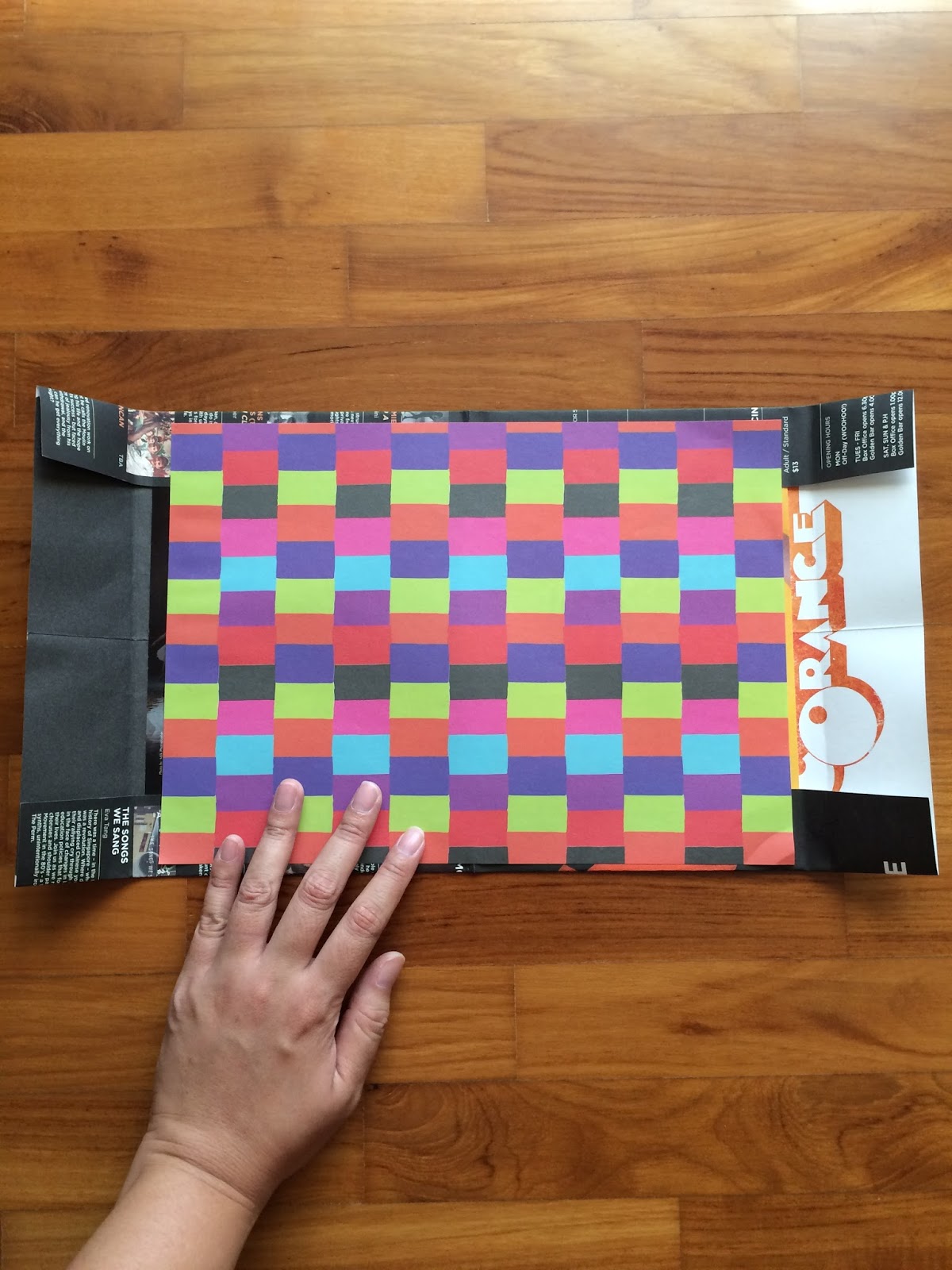
Paste your patterned paper on top of the cards. I used my existing stock of paper but if you want to more eco-friendly, use another brochure.
4. This part is where you will be making the pocket for the paper. Bear with me, because this could be a bit tricky for me to explain, but basically, you are making a pocket to slide in papers. Use the side where your back cover will be.

First, fold the short edges over the card. Then make another fold around 5mm away. Unfold the brochure and make 2 cuts where you folded it to the edge of the journal. It should look like the picture above, with one skinny bit and one fat bit to the left.


Fold it down so it looks like a little pocket. Apply glue to the flap, where my finger is pointing. Do the same to the other side.
5.

Once you have applied glue to both flaps, fold them down. You should now have something like a little folder, and when you close it, it should look like the pictures below.


6. You are nearly done! Slide in some paper like what I have done and make a victory sign! When you receive more junk mail, just slide it in.


And now, you can learn from my mistakes/observations...
What I learned:
- Leave more paper on the side to make a big pocket, especially if you intend to put more papers in or if you receive a lot of mail.
- You can also keep the papers in place by looping a rubber band or piece of string along the spine. I didn't because I was afraid it would crush it.
- You can also use letters with text. Apply gesso or white acrylic or paste blank sides on top to reuse them.
- Don't, for the love of administration, use important documents like current bank statements or policy statements or your birth certificate.
Have fun, people! If you did try this, post the photos of your journals in the comments!
Wednesday, July 06, 2016
Watercolour Flowers - Progress!
I had blogged earlier about my fail with watercolours, now I'm happy to report some progress!
Today I tried the watercolours again, after reading about the colour wheel and trying it out on the sketchbook. I felt I always used the same warm colours repeatedly so this time why not try a colour I don't use often? I also tried sketching some flowers (species of which I believe doesn't exist but who's caring?) and then painting them.
The pics below show the flowers as I painted:

 Felt the page was too empty, so added some background shading and flower shapes.

Today I tried the watercolours again, after reading about the colour wheel and trying it out on the sketchbook. I felt I always used the same warm colours repeatedly so this time why not try a colour I don't use often? I also tried sketching some flowers (species of which I believe doesn't exist but who's caring?) and then painting them.
The pics below show the flowers as I painted:

After sketching, I painted the basic colours I wanted.


Added some finer detail and definition to the petals with colour pencils.
Not perfect yet, but I'm proud of myself for the progress I made. It's all about taking pride in the small steps before the bigger ones! Not only that, I also realized that by doing so I achieved one of my personal goals for the month! Hooya~!
Seems that a few things helped:
- Knowing your equipment, eg, how much water comes out of my water brush, how much paint it can hold, how to press the brush to the paper. Practising with your equipment beforehand can make a big difference in results. This includes a few failures. :p
- Reading and researching what you can on your topic. I don't normally use purple and would not have done so if I didn't read about it in the library book I borrowed.
Onwards to the next goal!
Learning to Paint

Still, nothing is lost. I was in despair for a while, after all, not very encouraging to see your first work turn out ugly, yah? But I also thought that there were parts of the painting that I liked, so I started jotting them down. Then I thought about the ugly parts (ie the hair!) and jotted down what I thought I could do to do nicer stuff in the future.
This ties in with what I read about deliberate practice. Practising 10,000 times does not necessarily help you to improve, if you don't know what you have to do to improve in the first place. As you practise, you have to deliberately think about your strengths and flaws and ways to overcome them. You have to be aware about the end result you are trying to achieve and the steps you need to take in between to get there.
So this is what I have tried with this painting. Now I have a sense of the parts I need to do better, I can try again! Wish me luck!
Could this be better? Yes. Is this the end? No.
Sunday, July 03, 2016
Goals for July
After half a year, it's time to ask myself: how I am progressing with my personal goals?
Something Old
I finally restarted my piano this year. After finally having access to one, I realised how absorbing and fulfilling it is to play music that I loved. [I especially love the music of Les Miserables!] I rediscovered my writing skills and am finding that as long as I make the time for it, blogging is not really that difficult for me.
Art and creativity is also something that recurs again and again, whether it's drawing, doodling or larger pieces. I keep going back to my markers and I am loving my watercolours.
Photography was also pursued in many formats, film, digital and iPhone, and again, recurred again and again. I am loving taking photos with Pusheen >D and I keep wanting to put a camera in my bag.
These made me realize that although I have a wide variety of interests [gym, journalling, violin, piano, french, japanese, reading etc, etc] there are some that I kept going back to again and again. I guess you can call them my core interests and these are the ones that will define me for life.
Something New
Yet, I am ever curious to keep trying other stuff. So I will continue trying new stuff, new craft, new instruments (!), new languages and just trying to make the best of it however I can with my highly limited time and lifespan. These include:
- Learning French, Spanish, Italian, Indonesian, Cantonese (argh!!!)
- Playing the violin (I really, really ought to practise more)
- Crafting (bookbinding, journalling, sewing and others)
- Writing, blogging
And reading, reading, reading......
I do want to improve in what I do, rather than remain stagnant, so I thought of giving myself skill upgrades. This is when I either do additional research into a topic of interest or 'upping' the level of something I am currently doing. So for the rest of 2016, these are...
My Skill Upgrades
- Playing a grade 8 piece on the piano
- Learning how to do watercolours properly (started already, with a book from the library)
- Reading up on the various photography masters and doing film photo projects based on them (I started reading Henri Cartier-Bresson but no photo project yet!)
- Blogging at least once a week
- Doing some art at least once a month (to produce some really proper work!)
And to keep learning fresh,
My New Learning
- Continue to learn French grammar
- Practise the violin (I know, this comes up again and again......)
- Continue journalling and learning from other journalling gurus I follow online
- Writing, writing, writing. Writing book reviews. Writing diary entries. Writing better blog posts and reviews. Writing short stories. Writing a book. (Even if it doesn't get sold.)
Ok, so I know the limits of myself and my own time. I definitely won't be able to finish all these goals at once which is why I've been setting myself monthly ones. I have to pick and choose and try to balance my choices out.
So my personal goals for this month of July:
- Read up on my next photography master: Daido Moriyama
- Practise watercolours and do at least 2 pieces in my watercolour sketchbook (Otherwise, I buy for what??)
- Practise the violin (This is now crucial as my violin teacher will be away for a month! Help!!!)
- Start planning to write my book. Read and research first with the book I got. (Crossing fingers for this)
Ambitious enough? (sweat) But even if I don't meet all of them, and you know I don't always, er, at least I would hope the journey getting there makes it worth it. I might not reach the level of proficiency I would wish for but I would have gotten higher than where I was at first.
Crossing my fingers and wish me luck!
Something Old
I finally restarted my piano this year. After finally having access to one, I realised how absorbing and fulfilling it is to play music that I loved. [I especially love the music of Les Miserables!] I rediscovered my writing skills and am finding that as long as I make the time for it, blogging is not really that difficult for me.
Art and creativity is also something that recurs again and again, whether it's drawing, doodling or larger pieces. I keep going back to my markers and I am loving my watercolours.
Photography was also pursued in many formats, film, digital and iPhone, and again, recurred again and again. I am loving taking photos with Pusheen >D and I keep wanting to put a camera in my bag.
These made me realize that although I have a wide variety of interests [gym, journalling, violin, piano, french, japanese, reading etc, etc] there are some that I kept going back to again and again. I guess you can call them my core interests and these are the ones that will define me for life.
Something New
Yet, I am ever curious to keep trying other stuff. So I will continue trying new stuff, new craft, new instruments (!), new languages and just trying to make the best of it however I can with my highly limited time and lifespan. These include:
- Learning French, Spanish, Italian, Indonesian, Cantonese (argh!!!)
- Playing the violin (I really, really ought to practise more)
- Crafting (bookbinding, journalling, sewing and others)
- Writing, blogging
And reading, reading, reading......
I do want to improve in what I do, rather than remain stagnant, so I thought of giving myself skill upgrades. This is when I either do additional research into a topic of interest or 'upping' the level of something I am currently doing. So for the rest of 2016, these are...
My Skill Upgrades
- Playing a grade 8 piece on the piano
- Learning how to do watercolours properly (started already, with a book from the library)
- Reading up on the various photography masters and doing film photo projects based on them (I started reading Henri Cartier-Bresson but no photo project yet!)
- Blogging at least once a week
- Doing some art at least once a month (to produce some really proper work!)
And to keep learning fresh,
My New Learning
- Continue to learn French grammar
- Practise the violin (I know, this comes up again and again......)
- Continue journalling and learning from other journalling gurus I follow online
- Writing, writing, writing. Writing book reviews. Writing diary entries. Writing better blog posts and reviews. Writing short stories. Writing a book. (Even if it doesn't get sold.)
Ok, so I know the limits of myself and my own time. I definitely won't be able to finish all these goals at once which is why I've been setting myself monthly ones. I have to pick and choose and try to balance my choices out.
So my personal goals for this month of July:
- Read up on my next photography master: Daido Moriyama
- Practise watercolours and do at least 2 pieces in my watercolour sketchbook (Otherwise, I buy for what??)
- Practise the violin (This is now crucial as my violin teacher will be away for a month! Help!!!)
- Start planning to write my book. Read and research first with the book I got. (Crossing fingers for this)
Ambitious enough? (sweat) But even if I don't meet all of them, and you know I don't always, er, at least I would hope the journey getting there makes it worth it. I might not reach the level of proficiency I would wish for but I would have gotten higher than where I was at first.
Crossing my fingers and wish me luck!
Henri Cartier-Bresson [What I learned]
Readers of my blog [few you may be, but much treasured!] will know that I had just finished reading The Mind's Eye by Henri Cartier-Bresson, one of the most well-known photographers of the 20th century and responsible for the concept of the 'decisive moment'. After that, I was intrigued enough to find out more, so I bought another book which was a mix of biography and photo portfolio to learn more about him.
What I read was exciting in that it made me think more about what photography meant to me. There were lessons I picked up from the book and from his work, some of which I felt could be applied to my own photography skills, some I couldn't quite agree with, but hey, you can't win them all. These I have put in the form of Nutshells for me to remember much more easily.
So here, in a nutshell, are:
Know your Geometry
The Golden Ratio, the Golden Mean, the Rule of Thirds, Cartier-Bresson considered knowledge of these essential for good photography and used them in many of his most famous work. To him, you had to have a good understanding of how geometry affected composition to take a good photo. "In the beginning, there was the Word... Well, in my case: 'In the beginning, there was geometry.'" he said in an interview.
What I've Done
This shot is one that I feel shows geometry. The man is walking along a path which acts as a line of symmetry between the blocks of flats which flank him on either side. A flaw might be that the trees are not exactly symmetrical but at least they break up the monotony of the flats. (Plus, you can't always choose to move trees!) Could this shot have worked without the man? I don't think so, because I feel he adds some human element to it.

Nutshell: Be familiar with rules of composition and apply them in your photos.
Get yourself in and look at people.
No staying behind the camera and no selfie sticks for Cartier-Bresson. To really know where to catch the action, you have to be a participant in it. That means no telephoto lens from a distance, unless you are a tabloid paparazzi. Get into the midst of things, observe the people around and get up close to them.
What I've done
To get my shots at the CNY bazaar in Chinatown, for one, I actually had to be in the bazaar, instead of driving through in a car, or standing at the side alleys! I also had to observe the people around me and how the stall owners and customers were interacting.

Nutshell: Observe what's around you and participate
The last nutshell is one I especially like, that seems to encapsulate everything about photography:
“To photograph: it is to put on the same line of sight the head, the eye and the heart.”
Taken from Goodreads.
So have the head remember the rules, have the eye observe all and let your heart tell you when to press the shutter button. Practise, practise, practise till all of it is so embedded in your head it becomes a reflexive action. And take at least 10,000 photos. :)
What I read was exciting in that it made me think more about what photography meant to me. There were lessons I picked up from the book and from his work, some of which I felt could be applied to my own photography skills, some I couldn't quite agree with, but hey, you can't win them all. These I have put in the form of Nutshells for me to remember much more easily.
So here, in a nutshell, are:
My HCB Nutshells
Know your Geometry
The Golden Ratio, the Golden Mean, the Rule of Thirds, Cartier-Bresson considered knowledge of these essential for good photography and used them in many of his most famous work. To him, you had to have a good understanding of how geometry affected composition to take a good photo. "In the beginning, there was the Word... Well, in my case: 'In the beginning, there was geometry.'" he said in an interview.
What I've Done
This shot is one that I feel shows geometry. The man is walking along a path which acts as a line of symmetry between the blocks of flats which flank him on either side. A flaw might be that the trees are not exactly symmetrical but at least they break up the monotony of the flats. (Plus, you can't always choose to move trees!) Could this shot have worked without the man? I don't think so, because I feel he adds some human element to it.

Nutshell: Be familiar with rules of composition and apply them in your photos.
Get yourself in and look at people.
No staying behind the camera and no selfie sticks for Cartier-Bresson. To really know where to catch the action, you have to be a participant in it. That means no telephoto lens from a distance, unless you are a tabloid paparazzi. Get into the midst of things, observe the people around and get up close to them.
What I've done
To get my shots at the CNY bazaar in Chinatown, for one, I actually had to be in the bazaar, instead of driving through in a car, or standing at the side alleys! I also had to observe the people around me and how the stall owners and customers were interacting.

Nutshell: Observe what's around you and participate
The last nutshell is one I especially like, that seems to encapsulate everything about photography:
“To photograph: it is to put on the same line of sight the head, the eye and the heart.”
Taken from Goodreads.
So have the head remember the rules, have the eye observe all and let your heart tell you when to press the shutter button. Practise, practise, practise till all of it is so embedded in your head it becomes a reflexive action. And take at least 10,000 photos. :)
Thursday, June 23, 2016
June's Book review: The Mind's Eye by Henri Cartier-Bresson
So you might have noticed things have been slow on the blog for the past 2 weeks, that's because I've been on holiday! Now that I'm back, there's so much to catch up on doing! I want to:
- blog about the ideas I've been having
- Finish the travel journal of my trip
- Think about some new goals for July
- Think about how to upgrade some of my hobbies
And lastly, I have to think about how to start on some of the above! So I will start with a book review of a book I was reading in June.
The Mind's Eye by Henri Cartier-Bresson
 Henri Cartier-Bresson was a photographer and photojournalist. Born in France in 1908, he passed away in 2004. He took many iconic photos throughout his travels as a photojournalist and is most famous for coining the concept of the 'decisive moment'. (More on that later.) The book is a compilation of his writings from his photobooks and also includes essays on his travels.
I bought this book a long time back because I was intrigued by the idea of the decisive moment. I took it to mean a sudden instant in time where suddenly a great photographic shot would present itself. Before I left overseas, I thought it would be good to read the book on the way so that I might get some insight on how to find that 'decisive moment' on my trip.
While I wasn't entirely wrong about the decisive moment, I wasn't entirely right either as I found out from reading the book. I was intrigued enough to pick up another biography on Cartier-Bresson at a flea market later on holiday to find out more and from that book I learnt more about his style of photography. (blog idea: An essay on Cartier-Bresson!)
I would recommend Part 1 for photography enthusiasts. Here, Cartier-Bresson speaks from his perspective about what photography means to him and draws comparisons between photography and drawing. Keep in mind though that he worked a lot during the era of film, so you may have to understand a bit of film processing to really understand his views on darkroom processing and colour film.
Part 2 and 3 then moves on to essays on his travels and on the people he knows. Here are the chapters that some may skip but if you have to, read what he observes about travelling to Russia or China. After all, photography is not just the blind taking of photos, it is also about capturing life and how do you capture life if you are not a keen observer of it?
Overall, I found the book an easy read and it also inspired me enough to learn more about Cartier-Bresson, which I would write about later. (future blog post!) To me, a book that does that, is a good book indeed. :)
- blog about the ideas I've been having
- Finish the travel journal of my trip
- Think about some new goals for July
- Think about how to upgrade some of my hobbies
And lastly, I have to think about how to start on some of the above! So I will start with a book review of a book I was reading in June.
The Mind's Eye by Henri Cartier-Bresson
I bought this book a long time back because I was intrigued by the idea of the decisive moment. I took it to mean a sudden instant in time where suddenly a great photographic shot would present itself. Before I left overseas, I thought it would be good to read the book on the way so that I might get some insight on how to find that 'decisive moment' on my trip.
While I wasn't entirely wrong about the decisive moment, I wasn't entirely right either as I found out from reading the book. I was intrigued enough to pick up another biography on Cartier-Bresson at a flea market later on holiday to find out more and from that book I learnt more about his style of photography. (blog idea: An essay on Cartier-Bresson!)
I would recommend Part 1 for photography enthusiasts. Here, Cartier-Bresson speaks from his perspective about what photography means to him and draws comparisons between photography and drawing. Keep in mind though that he worked a lot during the era of film, so you may have to understand a bit of film processing to really understand his views on darkroom processing and colour film.
Part 2 and 3 then moves on to essays on his travels and on the people he knows. Here are the chapters that some may skip but if you have to, read what he observes about travelling to Russia or China. After all, photography is not just the blind taking of photos, it is also about capturing life and how do you capture life if you are not a keen observer of it?
Overall, I found the book an easy read and it also inspired me enough to learn more about Cartier-Bresson, which I would write about later. (future blog post!) To me, a book that does that, is a good book indeed. :)
Friday, June 03, 2016
Just 20 hours to learn anything?
I just read this article on my Facebook feed: http://time.com/4255801/learn-anything-20-hours/?xid=time_socialflow_facebook
Incredibly, 20 hours seems like a very short time, but read carefully what he is saying and it starts to make more sense.
One point I gathered: You don't have to aim for total mastery, just a high enough competence level to know when you are making mistakes and how to correct them. Neither do you have to go on a crash course. Even just 45 minutes a day is good enough.
The key seems to be a form of deliberate practice in which you do not practice blindly but you actively think about your mistakes and how to correct them. Think quality of work done over quantity.
This has been shown in research in many ways already, the power of incremental changes and deliberate practice. Do a quick google of these terms and you will see.
Then if the changes are so small, how do we keep motivating ourselves to keep going?
For this, I feel we should celebrate and appreciate small changes. For eg, I may not be able to speak French like a native by the end of this year, but I can already recognize more French words than I did before. And that's something more than what I had before I started. It's like saving money. 10 cents a day doesn't seem like very much, but keep at it and eventually you will save $100.
I'm about to take a hiatus from all the learning and go overseas! Still, I'm bringing along a couple of photography books to read on the flight or at night. I figure since I'm going to be taking tons of photos, why not read up on it along the way? Bonne journée!
Saturday, May 28, 2016
FilmOut, out and about
So after my previous try with the FilmOut, (reviewed in a previous blog post here) I thought the pictures were nice enough to give it one more try but that I had to be careful of light leaks. I loaded the camera with Kodak Gold 400 (never forget what film you are using again!) and set out with noble intentions.
Here are the better shots, the rest are also uploaded on my Lomohome:


So since this is a review, what are my thoughts on the camera?
- It's very small and so easy to carry around
- You will always know what kind of film you are using
- It's a crappy point and shoot, so don't expect good lenses, focus or flash capabilities. In fact, I had problems with the positioning because I would think I was holding it straight but some of the pictures turned out slightly crooked. This is a problem I never had with my other (larger) point and shoots.
But the main lesson that was reinforced with this camera is a simple one that anyone following photography should remember:
I'm not sure where I read this or which photographer said this, but always in basic photography, if you are mindful of where the light is, you cannot go wrong.
I applied this a lot when I was using the FilmOut and always made sure there was natural light coming from somewhere. (Indoor lighting does not work as well, the pictures will still turn out dark on film) Even in the indoor shots, as long as there was a natural light source somewhere, the picture still developed nicely. (although I'm still surprised at the amount of natural light that shone into the Ritz-Carlton)
It doesn't mean that anyone with a DSLR and a couple of huge-ass lenses can become a great photographer. Much still depends on the skill and eye of the person behind the camera. Learn some of the basic concepts of photography, like the rule-of-thirds and composition, experiment a lot, learn from your mistakes and even with a $10 crappy camera, you can still take good pictures. :)
Other stuff:
I found another blogger online who bought the same camera! You can see his photos here.
This is a good page on taking photos with digital point and shoots at Petapixel.
Another photographer who shoots from the hip is Daido Moriyama. Here is a video showing how he works.
Inspired to try one? The Lomography website has tons of photos taken by film point-and-shoot cameras. This is what I got from one search.
Here are the better shots, the rest are also uploaded on my Lomohome:


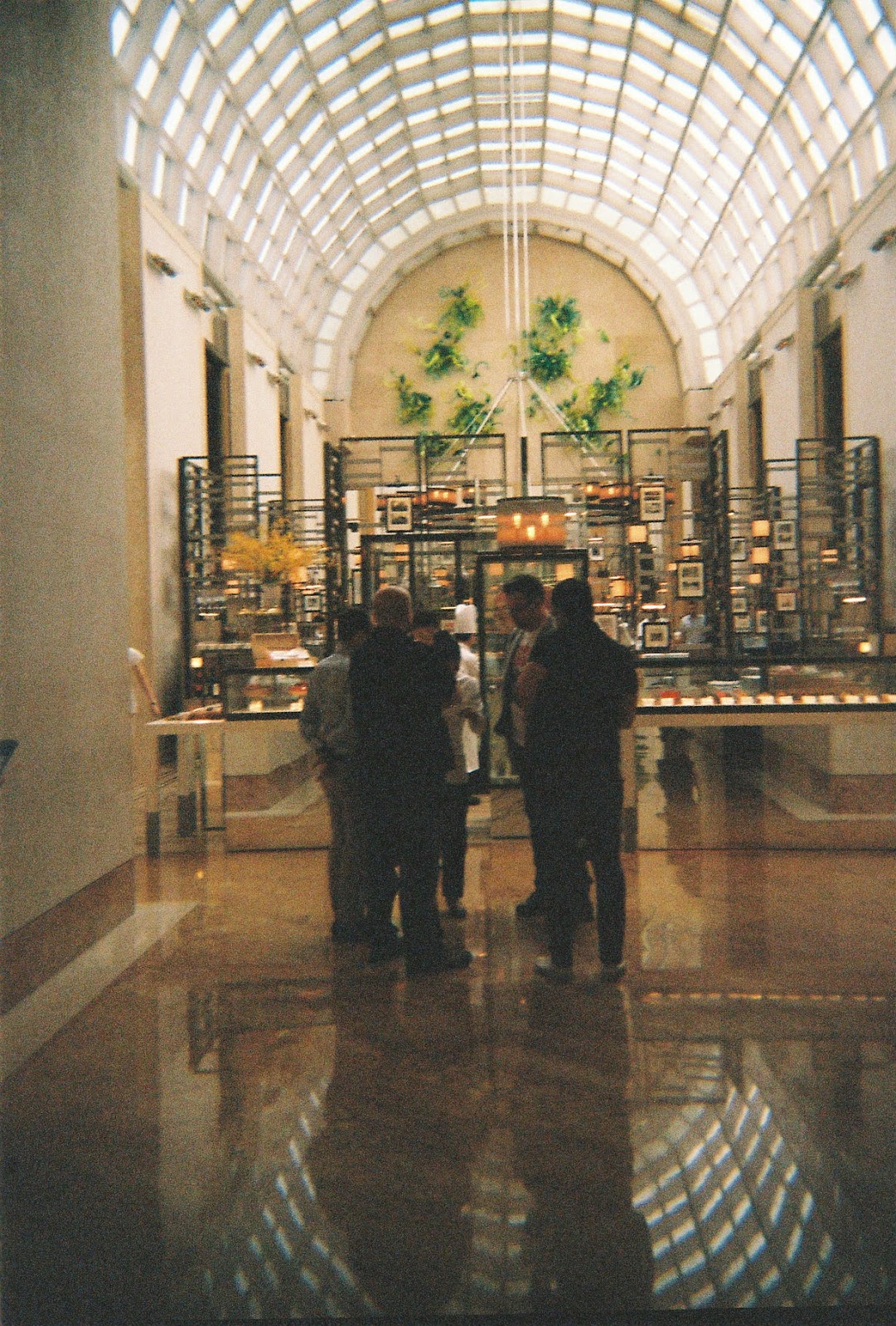
(I'm amazed at how much natural light there is in the Ritz)


So since this is a review, what are my thoughts on the camera?
- It's very small and so easy to carry around
- You will always know what kind of film you are using
- It's a crappy point and shoot, so don't expect good lenses, focus or flash capabilities. In fact, I had problems with the positioning because I would think I was holding it straight but some of the pictures turned out slightly crooked. This is a problem I never had with my other (larger) point and shoots.
But the main lesson that was reinforced with this camera is a simple one that anyone following photography should remember:
Always follow the light
I'm not sure where I read this or which photographer said this, but always in basic photography, if you are mindful of where the light is, you cannot go wrong.
I applied this a lot when I was using the FilmOut and always made sure there was natural light coming from somewhere. (Indoor lighting does not work as well, the pictures will still turn out dark on film) Even in the indoor shots, as long as there was a natural light source somewhere, the picture still developed nicely. (although I'm still surprised at the amount of natural light that shone into the Ritz-Carlton)
It doesn't mean that anyone with a DSLR and a couple of huge-ass lenses can become a great photographer. Much still depends on the skill and eye of the person behind the camera. Learn some of the basic concepts of photography, like the rule-of-thirds and composition, experiment a lot, learn from your mistakes and even with a $10 crappy camera, you can still take good pictures. :)
Other stuff:
I found another blogger online who bought the same camera! You can see his photos here.
This is a good page on taking photos with digital point and shoots at Petapixel.
Another photographer who shoots from the hip is Daido Moriyama. Here is a video showing how he works.
Inspired to try one? The Lomography website has tons of photos taken by film point-and-shoot cameras. This is what I got from one search.
Sunday, May 22, 2016
Craft: Notepad holder
I have a secret guilty pleasure: I like notebooks. I especially love those with blank empty pages because they feel full of potential to become full of well-drawn sketches and interesting ideas, whether or not I actually manage to fill them up!
From a love of notebooks, one day, I discovered the art of bookbinding and realized another thing: Instead of buying notebooks and collecting them, I could make them for myself! What a brilliant thing!
So every now and then, I experiment and try my luck with scrap paper and cheap notepads. Sometimes I have total disasters that I have to throw, sometimes I land up with something that just maybe is usable and sometimes, I have a success!
This one I made is closer to a success. I thought of doing a notepad holder because I have a bunch of A6 notepads which are easier to carry around than my larger journal, and I also thought they would look nicer in a holder that I could re-use every time the paper ran out. I have a bunch of paper and thin card and I had a Typo envelope that I liked the look of, so why not?
I finished this in one afternoon (with one loooong break in between for lunch and shopping) and I'm quite happy with the result. It looks nice and because I used more cardboard, it's stiff enough to hold the notepad without bending. Also with the elastic band, I can take out the notepad and change it with a new one when the paper runs out.
And so, the instructions!
Crafting a Notepad Holder
You will need:
Paper for the cover (I used a Typo envelope)
Paper for the inside cover (mine is a striped pattern, from a book I got from Daiso)
Thin cardboard (I used free flyers)
An elastic band (you can buy a packet from Daiso)
Scissors
Glue
Stapler or needle and thread
Instructions:


2. Cut the envelope and choose one side to be the front cover. Then put it down facing downwards and lay the cardboard on top. Fold down the edges and glue them down. The cardboard will add strength to the holder.

 3. Take the coloured paper for your inside cover. Measure it so that it fits and paste it down. If the front cover is longer like mine is, fold the edges inward like in the 2nd picture.

 4. To attach the notepad, I stretched a piece of elastic across the notepad so that I knew how long a piece I needed. I then cut it off and because I'm a lazy boredslacker, I stapled the elastic to the cover. More hardworking types can use needle and thread to sew it on.


 The finished notepad holder, from the outside and the inside with the notepad inside. For a personal touch, I took some excess paper that I had cut off for the inside cover and pasted it on the outside.
Looks great in pictures, but mind you, I did not show you:
- The mess of paper and stationery strewn around me on the floor
- My intense concentration when cutting and measuring and praying that I didn't do something wrongly
- Me having to stop every 10 minutes to position the materials nicely so that I could take a shot for the blog
- My irritated grunts when I found out I had stapled the elastic band wrongly and had to take out the staples
- More grunting when I was done and had to clean up the mess
- The holder doesn't close snugly so to close it, I had to loop an elastic band around it
Still, I do think it looks good. Can't wait to fill this with well-drawn pictures and interesting ideas. ( fingers crossed )
From a love of notebooks, one day, I discovered the art of bookbinding and realized another thing: Instead of buying notebooks and collecting them, I could make them for myself! What a brilliant thing!
So every now and then, I experiment and try my luck with scrap paper and cheap notepads. Sometimes I have total disasters that I have to throw, sometimes I land up with something that just maybe is usable and sometimes, I have a success!
This one I made is closer to a success. I thought of doing a notepad holder because I have a bunch of A6 notepads which are easier to carry around than my larger journal, and I also thought they would look nicer in a holder that I could re-use every time the paper ran out. I have a bunch of paper and thin card and I had a Typo envelope that I liked the look of, so why not?
I finished this in one afternoon (with one loooong break in between for lunch and shopping) and I'm quite happy with the result. It looks nice and because I used more cardboard, it's stiff enough to hold the notepad without bending. Also with the elastic band, I can take out the notepad and change it with a new one when the paper runs out.
And so, the instructions!
Crafting a Notepad Holder
You will need:
Paper for the cover (I used a Typo envelope)
Paper for the inside cover (mine is a striped pattern, from a book I got from Daiso)
Thin cardboard (I used free flyers)
An elastic band (you can buy a packet from Daiso)
Scissors
Glue
Stapler or needle and thread
Instructions:


1. Measure the flyers and cut them to fit your notepad. ( I was lucky because the flyers I chose were just half a inch larger than my notepad, so no cutting here for me ) Then stick them together so that they are as hard as a paperback's cover. ( I used two, but if you have good quality cardboard, you could probably just use one.) Since I used two pieces of different sizes, I also cut the four corners off so I could fold the edges down. I felt this would give the edges extra strength.
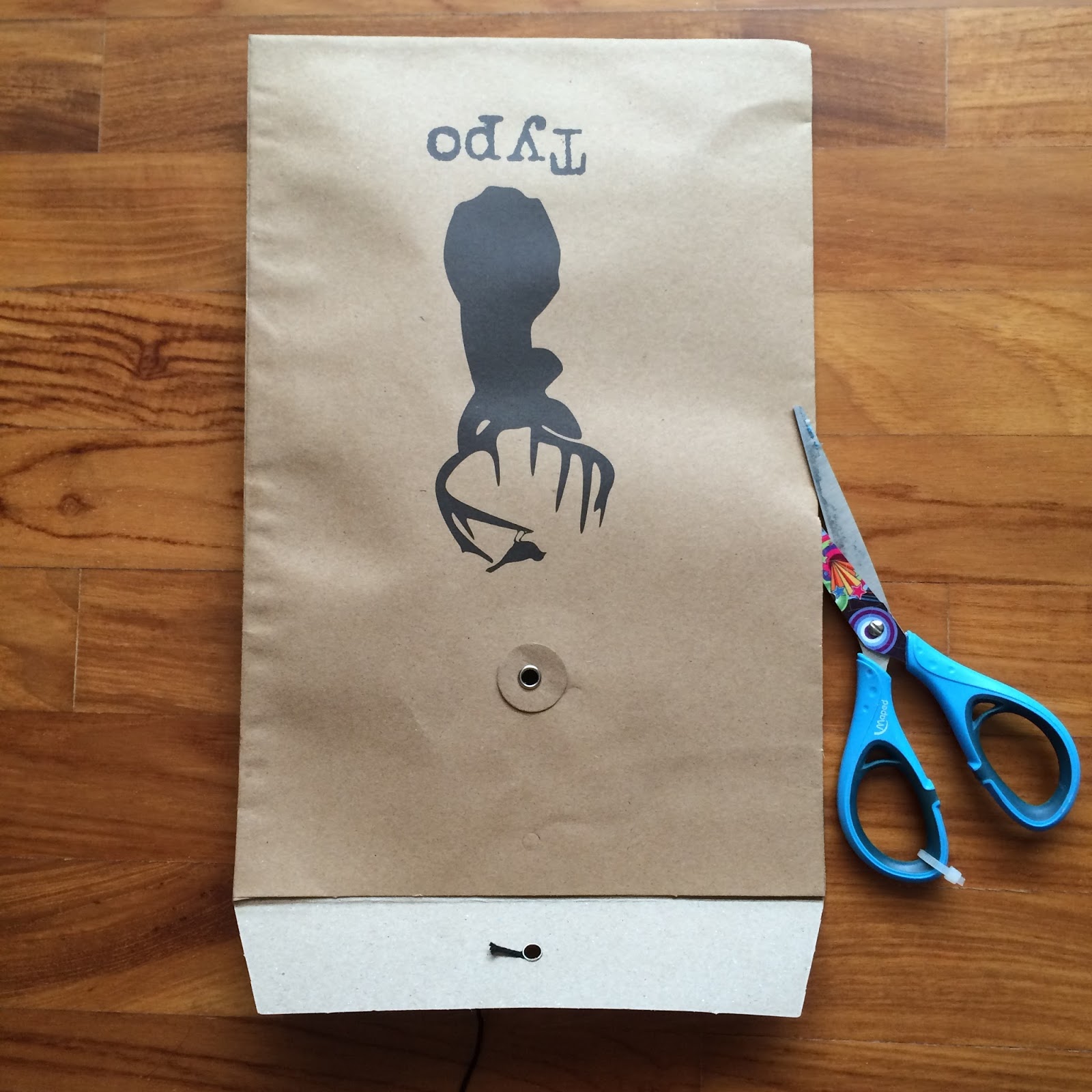


Looks great in pictures, but mind you, I did not show you:
- The mess of paper and stationery strewn around me on the floor
- My intense concentration when cutting and measuring and praying that I didn't do something wrongly
- Me having to stop every 10 minutes to position the materials nicely so that I could take a shot for the blog
- My irritated grunts when I found out I had stapled the elastic band wrongly and had to take out the staples
- More grunting when I was done and had to clean up the mess
- The holder doesn't close snugly so to close it, I had to loop an elastic band around it
Still, I do think it looks good. Can't wait to fill this with well-drawn pictures and interesting ideas. ( fingers crossed )
Sunday, May 15, 2016
Art Day Out at Gillman Barracks, 14 May 2016
Every so often, I feeling like expanding the hub's artistic horizons, so I will pull him off to some art exhibition or other where he will see things that leave him in total incomprehension.
Art Day Out at Gillman was no exception. This is a day where the galleries at Gillman open their doors and all are free to come. Other than the galleries, there were also artists in residence from NTU and an area for children to play with art materials. To top off the Day, when you reached the last of the galleries, there was also a vintage flea mart and eating places as well.
I don't know if the hub's artistic horizons were expanded, but I can be sure on the total incomprehension, from the look of confused bewilderment on his face from gallery to gallery. Would you 'get' the following artwork?
1. All that glitters is not gold, it's guns too.


Art Day Out at Gillman was no exception. This is a day where the galleries at Gillman open their doors and all are free to come. Other than the galleries, there were also artists in residence from NTU and an area for children to play with art materials. To top off the Day, when you reached the last of the galleries, there was also a vintage flea mart and eating places as well.
I don't know if the hub's artistic horizons were expanded, but I can be sure on the total incomprehension, from the look of confused bewilderment on his face from gallery to gallery. Would you 'get' the following artwork?
1. All that glitters is not gold, it's guns too.

2. The art is in the hidden message. See if you can spot it.


3. I wish I had such art assignments when I was in school. This is Art Outreach, they are an educational non-profit that promotes art through programmes such as art and cultural heritage tours, school programmes and they have a visual thinking lab at Gillman. Check them out on Facebook because they have programmes for adults and children alike.


I do want to spend a bit more time writing on the following exhibition because it turned out to be my favourite out of the Day and they are from the exhibition Reflections on Still Water by Zheng Lu. Zheng Lu is a Beijing-based artist and he created works out of stainless steel to look like splashes of moving water. Most remarkably, when you look up close, the sculptures are made out of thousands of Chinese characters.


The ones I've captured here are only the small ones. There was also a large splash inside which went over the room! They really caught my attention because although they were made from hard steel, the sculptures still looked very fluid and it felt like they were in motion even though they were steel.
Or they looked like a Harry Potter spell frozen in mid-air.
Reflections on Still Water is held at the Sundaram Tagore gallery from now till May 19. This will bring you to their website.
The other I found interesting was one held at the Pearl Lam Gallery entitled The Third Script, a two-person exhibition by Boo Junfeng and Linda CH Lai. Their exhibition was a reflection on how our identity and recollection of the past are formed and how incomplete and non-linear perspectives can skew our memories.
The most touching part of this, (other than the incomprehensible parts) was a short film by Boo called Parting. The film is about a Malaysian man suffering from dementia who comes to Singapore to look for his long-lost lover whom he left behind....... in the 1960s. I found the scenes with the man very touching as he went through Woodlands and plodded his way through Singapore. He walked around with a bewildered expression through most of the film (kinda like the hub that day) and his tenacity finally led him to the school where she worked. Did he find her? I'll let you go to the gallery to discover for yourself. :p
The Third Script is held at Pearl Lam Gallery till 19 June. This is their website.
So in the end, after seeing all these, are these Art?

Well, maybe it really depends on the beholder.
I did wish more of the galleries would make an effort to promote their art. Most of the information I wrote above came from media release notes and curatorial notes that the galleries were giving out that day. The reason why some are better written than others is that these galleries actually had the notes to give out. Also, the staff in the galleries mostly left us to wander around and there weren't much information put up. Um, if you do hold a public event inviting the public to come, you could be a bit more inviting.......? Guess they weren't impressed by my Pusheen keychain.
Well, you do have to consider they are a gallery, not a museum, which means they are also interested in selling the artworks to worthy buyers and unfortunately the only way I could bring home any of their art was to pilfer the free postcards.
Maybe one day, who knows? Meanwhile, for more free art, I offer you the following photographic artwork.

I think I'll call it: "Total Artistic Incomprehension".
Subscribe to:
Posts (Atom)